FAG vs SKF Bearing Load Rating per DIN ISO 281 Wholesale Supplier
Same model number, different load rating — and neither brand is wrong.
FAG and SKF both calculate dynamic load ratings under DIN ISO 281, yet their published values for identical model numbers often differ noticeably. The reason lies in brand-specific internal geometry coefficients, material grade assumptions, and modification factors embedded in each manufacturer’s calculation method. Directly comparing catalog numbers without recalculating under a unified framework leads to wrong selection, especially in high-temperature or heavy-load applications.
I still remember a hot afternoon at a copper mine in Antofagasta. The maintenance crew pulled a spherical roller bearing off a conveyor head pulley after only a few months in service. The outer ring was discolored, the cage was cracked, and the rollers showed signs of severe skidding. The site procurement manager walked over with an SKF catalog in one hand and our delivery note in the other, pointing at the dynamic load rating column. "Your FAG bearing is rated lower than the SKF one for the same model number," he said. "Are you selling us inferior product?" I pulled out a caliper and measured the outer ring width right there on the shop floor. The bearing we supplied was correct in model designation but carried a standard internal clearance suffix instead of the high-temperature clearance suffix the application actually required. Under operating heat, the internal preload surged past design limits, the lubricant film collapsed, and the cage failed. The load rating on paper had nothing to do with the failure — but the misunderstanding around it nearly killed the relationship [NEED_CITE: root cause distribution of spherical roller bearing failures in mining conveyors per ISO 15243].
That episode reshaped how I approach every cross-brand inquiry. Before quoting, I now walk buyers through the DIN ISO 281 calculation structure itself, showing where the numbers come from and why they diverge.
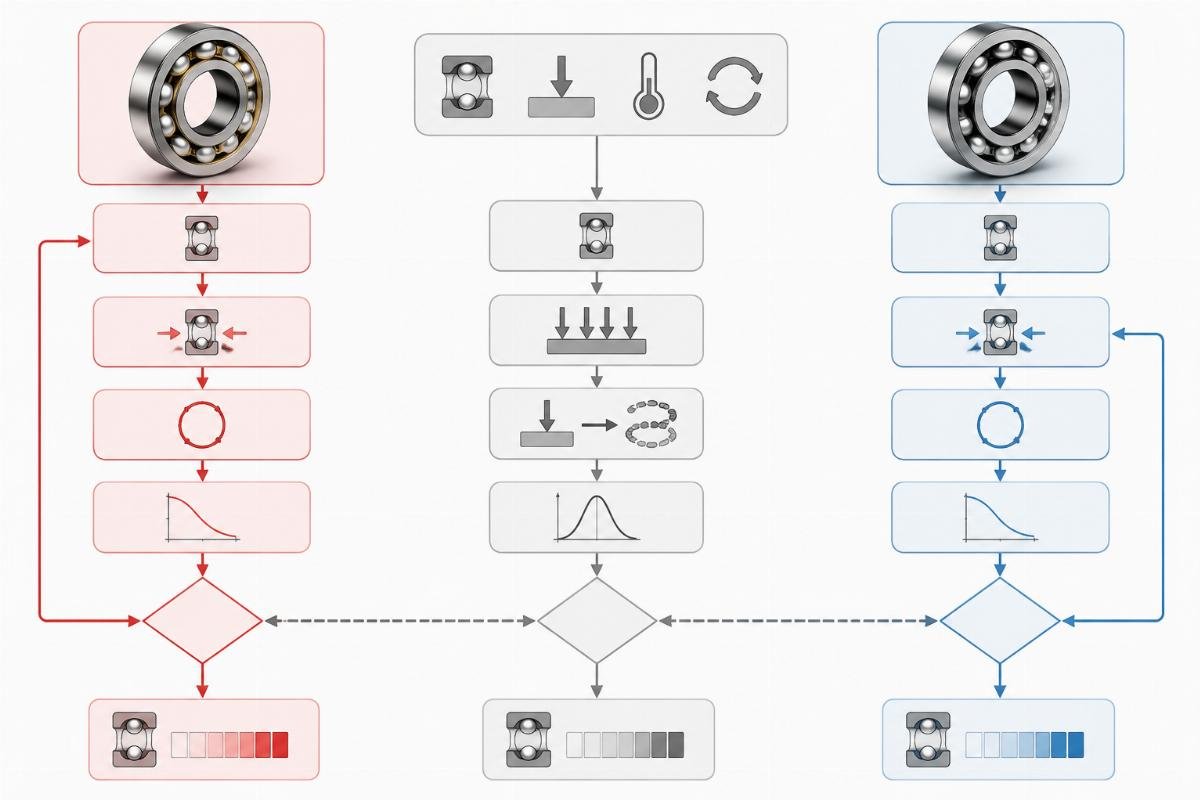
Let me break down exactly what happens inside that standard, how the two brands interpret it differently, and how you can verify load data before placing an order.
Why Do FAG and SKF Show Different Load Ratings for the Same Model?
Both manufacturers follow DIN ISO 281, but the standard allows room for brand-specific geometry factors and material assumptions that shift the final number.
The DIN ISO 281 framework defines the basic dynamic load rating C as the constant radial load a bearing can endure for a basic rating life of one million revolutions [NEED_CITE: DIN ISO 281 basic rating life definition and calculation scope]. The formula structure is universal: C depends on geometry factors, material factors, and load capacity equations. However, the standard does not dictate the exact internal contour of raceway grooves, the precise curvature sum parameters, or the specific material cleanliness grade each manufacturer assumes as baseline.
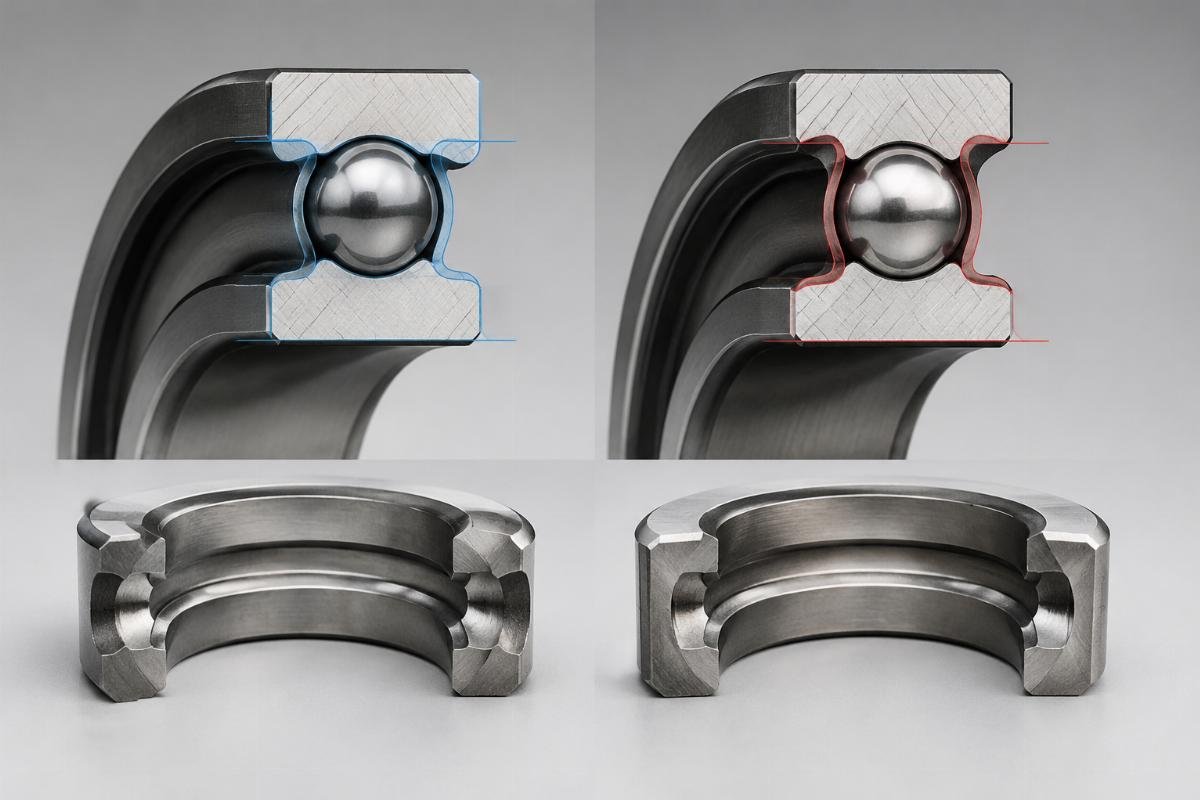
Here is where the divergence begins. FAG’s engineering team applies its own set of internal geometry coefficients derived from decades of raceway profiling and contact stress analysis. SKF uses a parallel set of coefficients rooted in its own design philosophy and manufacturing history. Both are valid under the standard. Neither is "more correct." The result is that a 22320 spherical roller bearing from FAG may show a dynamic load rating that differs from the SKF 22320 by a noticeable margin — sometimes higher for one brand, sometimes higher for the other, depending on the series and size range.
A Latin American distributor once sent me a spreadsheet comparing every model in our catalog against SKF’s published values. For tapered roller bearings in the 322 series, our FAG numbers were slightly lower on certain sizes. For deep groove ball bearings in the 6206 size, they were slightly higher. The distributor assumed the lower numbers meant weaker product. In reality, the differences reflected each brand’s chosen contact angle assumptions, roller profile corrections, and baseline material fatigue limit inputs [NEED_CITE: bearing manufacturer calculation coefficient variations under ISO 281].
| Factor | FAG Approach | SKF Approach |
|---|---|---|
| Internal geometry coefficients | Brand-specific raceway curvature design | Brand-specific raceway curvature design |
| Material baseline assumption | Standard high-quality hardened bearing steel per DIN ISO 281 | Standard high-quality hardened bearing steel per DIN ISO 281 |
| Modification factor aISO | Calculated per FAG’s lubrication and contamination models | Calculated per SKF’s lubrication and contamination models |
| Published C value | Reflects FAG’s internal parameter set | Reflects SKF’s internal parameter set |
| Cross-brand comparability | Not directly comparable without recalculation | Not directly comparable without recalculation |
The practical takeaway: if your equipment manual specifies an SKF bearing with a certain C value, and you are sourcing an FAG cross-reference, you cannot simply match model numbers and assume load equivalence. You must verify the application’s required basic rating life, recalculate using the target brand’s published C value, and confirm the result meets or exceeds the original design requirement.
How to Recalculate Load Ratings Under DIN ISO 281 Correctly
You need the brand-specific coefficient set and the actual application parameters — not just the catalog number.
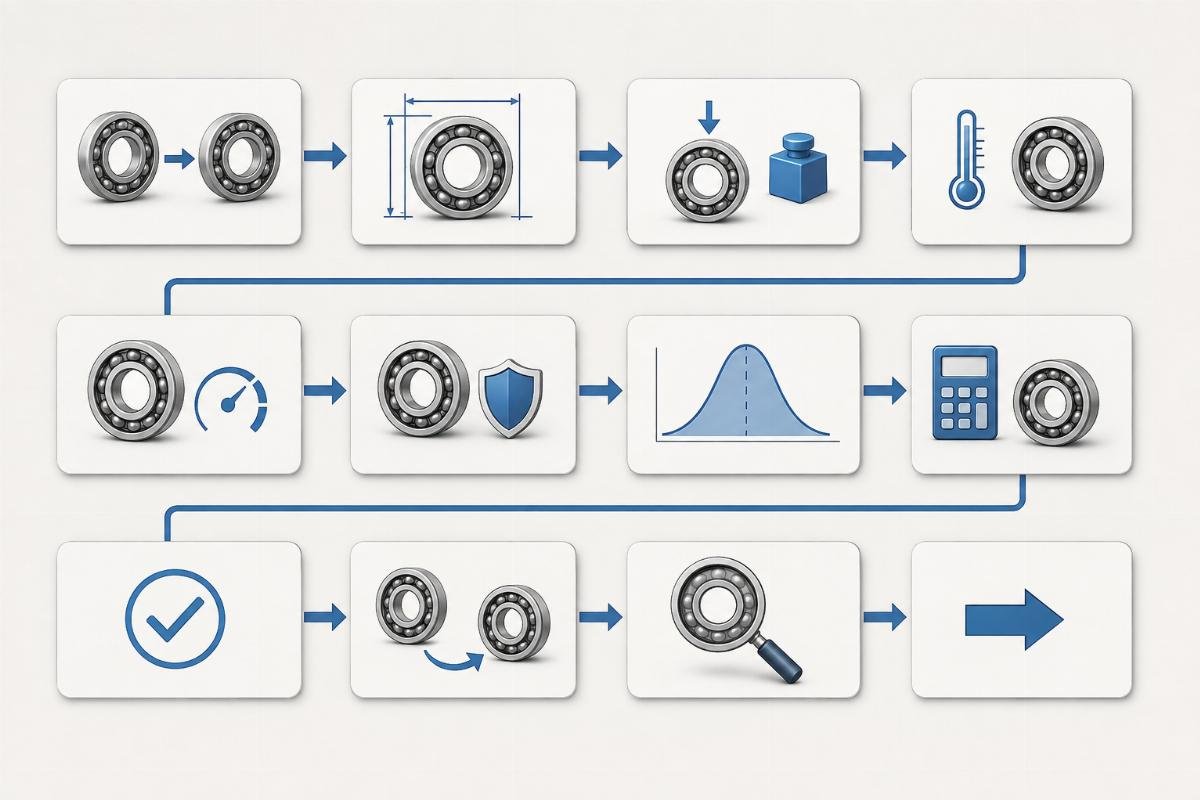
The DIN ISO 281 calculation follows a structured sequence. First, you determine the basic dynamic load rating C from the manufacturer’s catalog. Second, you calculate the equivalent dynamic bearing load P based on actual radial and axial forces in your application. Third, you compute the basic rating life L10 using the formula L10 = (C/P)^p, where p equals 3 for ball bearings and 10/3 for roller bearings [NEED_CITE: DIN ISO 281 basic rating life formula structure and exponent values]. Fourth, you apply the modified rating life calculation using the aISO factor, which accounts for lubrication conditions, contamination level, and material fatigue limit.
Here is the step-by-step method I use when a buyer asks whether an FAG bearing can replace an SKF bearing in a specific position:
-
Extract the application load data. Obtain the actual radial load, axial load, and any shock or vibration factors from the machine builder’s documentation or from现场 measurement. Do not rely on the previous bearing’s catalog rating alone — the machine may have been modified since original installation.
-
Identify the required basic rating life. Most industrial applications target L10h between 30,000 and 50,000 hours for continuous duty. Mining conveyors and heavy-duty gearboxes often require higher values. Confirm the target with the maintenance team.
-
Pull the C value from the target brand’s current catalog. If replacing SKF with FAG, use FAG’s published C for that model. Do not carry over the SKF number.
-
Calculate equivalent load P. Apply the correct X and Y factors from the target brand’s catalog, as these also differ between manufacturers depending on contact angle and internal design.
-
Apply the aISO modification factor. This is where brand differences become most visible. FAG and SKF each provide their own aISO calculation tools or lookup tables based on lubricant viscosity ratio, contamination codes, and fatigue load limits. Using the wrong brand’s aISO data will skew the modified life result [NEED_CITE: aISO modification factor calculation differences between bearing manufacturers].
-
Compare the modified rating life against the target. If the result meets or exceeds the required L10h, the substitution is technically valid. If not, move to the next larger size or a different internal design variant.
A European pulp mill operator once called me about a cylindrical roller bearing replacement on a dryer roll. The original SKF bearing had a published C value that was noticeably higher than the FAG equivalent in the same size. The operator assumed the FAG bearing would fail sooner. After walking through the recalculation with actual load data and the mill’s lubrication regime, the modified rating life for the FAG bearing actually exceeded the requirement by a comfortable margin. The aISO factor for FAG’s calculation, given the mill’s oil bath lubrication and cleanliness level, compensated for the lower basic C value. The FAG bearing ran substantially longer than the previous service interval.
How to Avoid Load Miscalculation Failures in High-Temperature Applications
Internal clearance selection matters more than the catalog load rating when operating temperature rises.
The Antofagasta incident I mentioned earlier is not unique. High-temperature environments — kilns, dryers, steel mill run-out tables, hot gas fans — expose a hidden variable that the DIN ISO 281 basic rating calculation does not automatically address: thermal expansion and its effect on internal clearance.
When a spherical roller bearing operates at elevated temperature, the inner ring, outer ring, and rollers all expand. If the radial internal clearance is too tight for the temperature differential between inner and outer ring, the bearing develops excessive internal preload. This preload dramatically increases friction, generates additional heat, degrades the lubricant, and accelerates fatigue — regardless of what the catalog C value says.
The standard clearance groups defined in ISO 5753 provide the framework: CN (normal), C3 (increased), C4 (larger increased), and so on [NEED_CITE: ISO 5753 radial internal clearance groups for spherical roller bearings]. In high-temperature service, C3 or C4 clearance is typically required to accommodate the differential expansion. Selecting CN clearance in a hot application is one of the most common specification errors I encounter in the field.
Here is how I guide buyers through clearance selection for thermal environments:
-
Determine the operating temperature range. Measure or estimate the inner ring temperature (shaft temperature) and outer ring temperature (housing temperature). The differential between these two values drives the expansion calculation.
-
Calculate the required residual clearance. Subtract the thermal expansion of inner ring, outer ring, and rollers from the initial installed clearance. The result must remain positive and within the bearing manufacturer’s recommended operating range.
-
Select the appropriate clearance group. If the calculated residual clearance falls below the minimum recommended value with CN clearance, move to C3. If C3 is still insufficient, move to C4.
-
Verify the load rating under operating conditions. High temperature also affects material properties and lubrication film thickness. The aISO factor must be recalculated for the actual operating temperature, not the standard reference temperature used in the catalog.
A Middle East cement plant replaced the fan bearings on their rotary kiln with a batch of spherical roller bearings specified as CN clearance. Within weeks, the bearings ran hot, the grease carbonized, and one fan seized. The maintenance team blamed the bearing quality. The real issue was that the kiln hood area operated at temperatures where CN clearance could not survive. After switching to C4 clearance and verifying the residual clearance calculation, the new bearings operated within normal temperature range and delivered extended service life.

How to Verify Load Data from Your Bearing Supplier
Ask for the calculation basis, not just the catalog number.
When you receive a quotation from a bearing supplier, the document typically lists model numbers, quantities, unit prices, and sometimes the basic dynamic load rating pulled from a catalog. For standard applications with well-established load conditions, this may be sufficient. For critical applications — mining, steel, power generation, heavy industrial — it is not.
I recommend requesting the following from your supplier before finalizing a cross-brand substitution:
-
The catalog source and edition. Bearing manufacturers update their catalogs periodically. A C value from a catalog printed several years ago may differ from the current edition due to design revisions or calculation method updates. Confirm the supplier is referencing the latest published data.
-
The aISO calculation input parameters. Ask what lubrication condition, contamination level, and fatigue load limit the supplier used for the modified rating life calculation. If the supplier cannot provide this, they may not have performed the calculation at all.
-
The clearance specification. Confirm that the quoted bearing carries the correct internal clearance suffix for your application. A model number without a clearance suffix typically defaults to CN, which may be wrong for your operating conditions.
-
Authenticity verification support. Counterfeit bearings remain a serious risk in global supply chains. A reputable supplier should be able to provide traceability documentation, manufacturer origin confirmation, and guidance on how to verify authenticity through the brand’s official channels [NEED_CITE: counterfeit bearing identification methods and authorized channel verification].
When I work with new buyers, especially those sourcing through trading channels, I make it a point to share the calculation worksheet alongside the quotation. This transparency eliminates guesswork and reduces the risk of field failures that end up costing far more than the bearing itself. Our cross-reference support covers the full range of major brands — SKF, FAG, NSK, TIMKEN, NTN, KOYO — and we verify origin and authenticity for every shipment. If a buyer needs an FAG 22320 E1 to replace an SKF 22320 E, we provide the load comparison calculation, the clearance verification, and the origin documentation in one package.

Conclusion
Load ratings are not universal constants — they are brand-specific calculations under a shared standard.
FAG and SKF both operate within DIN ISO 281, but their internal design coefficients, material assumptions, and modification factor methods produce different published C values for the same model number. Direct catalog comparison without recalculation is a selection error waiting to happen. By understanding the calculation structure, applying the correct brand-specific parameters, matching internal clearance to actual operating temperature, and demanding calculation transparency from your supplier, you can make confident cross-brand substitutions that perform reliably in the field.