FAG vs SKF Bearing Cage Material Comparison: Wholesale Supplier Guide
Most buyers assume identical FAG and SKF part numbers share the same cage material. They don’t.
FAG and SKF use entirely different default cage materials and suffix coding systems. SKF deep groove ball bearings default to pressed steel cages (suffix J207), while FAG defaults to machined brass cages (suffix M) for the same size range. Cross-brand substitution without verifying suffix codes leads to mismatched speed limits, lubrication requirements, and premature field failures.
I still remember the first shipment I sent to a steel mill in the Gulf region. The buyer had been running SKF deep groove ball bearings with pressed steel cages for years. When they asked me to source the same size from FAG, I quoted and shipped without double-checking the cage suffix. What arrived was a full batch of FAG bearings with machined brass cages as the default configuration. The buyer called within days — the noise profile was different, the running-in behavior was different, and the high-speed spindle application they had was suddenly showing vibration issues. That shipment almost cost us the entire account. Since then, I’ve made it a rule: never assume, always verify the suffix. Every single time. [NEED_CITE: SKF default cage material configuration per SKF bearing designation system]
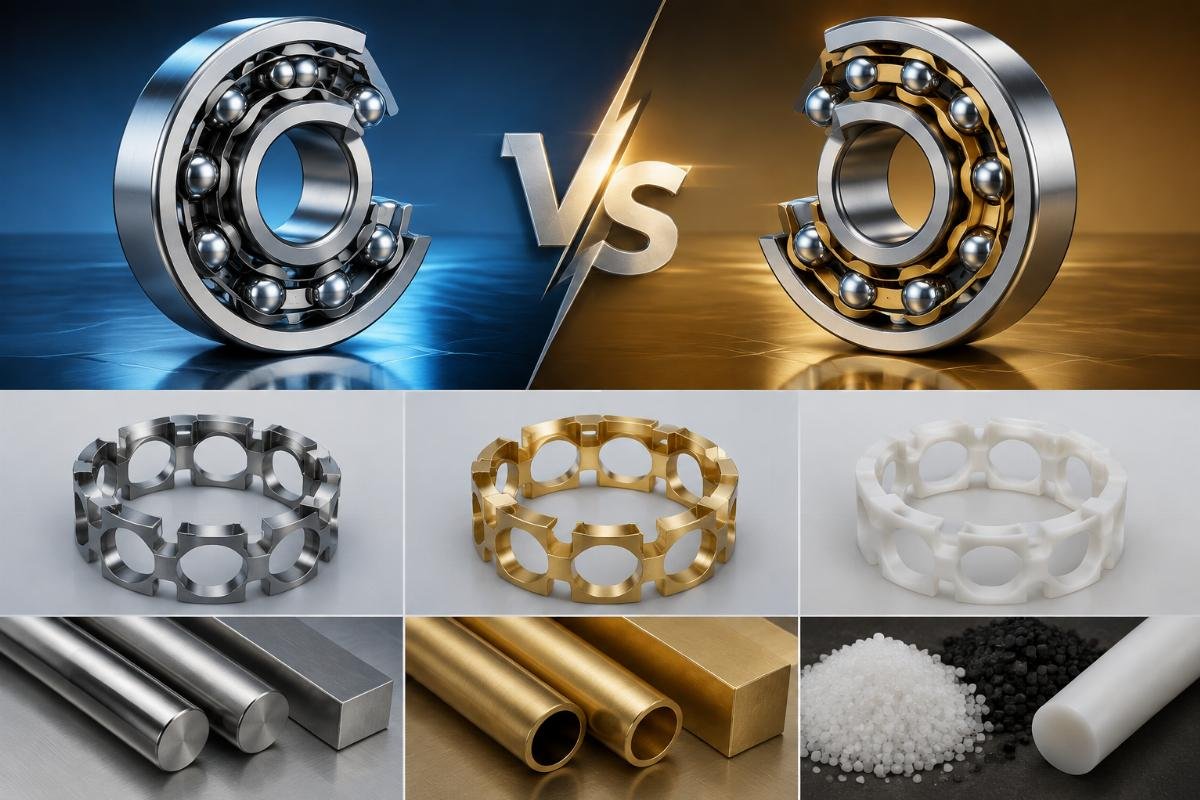
Let me walk you through exactly how the two systems differ, how to read the codes, how to pick the right material for your application, and how to verify what actually arrives at your warehouse.
What Are the Default Cage Materials for FAG vs SKF?
SKF and FAG assign different default cage materials to the same bearing types, meaning a bare part number from each brand does not guarantee the same cage.
When you order an SKF 6206 with no suffix, you receive a bearing with a pressed steel cage. When you order an FAG 6206 with no suffix, you receive a bearing with a machined brass cage. This is not a minor footnote — it fundamentally changes how the bearing performs under speed, temperature, and lubrication conditions. [NEED_CITE: SKF bearing designation system default cage material rules]
SKF’s engineering philosophy has long favored pressed steel cages as the standard for general-purpose deep groove ball bearings. Steel cages are lightweight, cost-effective, and suitable for the majority of industrial applications running at moderate speeds and temperatures. SKF reserves machined brass and polymer cages for specific suffix-designated variants. [NEED_CITE: SKF general catalog cage material selection guidelines]
FAG, by contrast, has historically positioned machined brass as the default cage for many of its deep groove ball and spherical roller bearing lines. The reasoning relates to FAG’s traditional strength in heavy industry and mining applications, where brass cages offer better guidance accuracy and higher tolerance to misalignment under heavy radial loads.
Here’s what this means in practice for cross-brand sourcing:
| Parameter | SKF Default | FAG Default |
|---|---|---|
| Deep groove ball cage | Pressed steel | Machined brass |
| Suffix for steel cage | J207 | J52 |
| Suffix for brass cage | M | M (no suffix needed) |
| Suffix for polymer cage | P | TVP / TVP2 |
| Typical speed suitability | Moderate to high | Moderate |
| Heavy load tolerance | Standard | Enhanced |
A distributor in North Africa once ordered a full container of spherical roller bearings for a cement plant. The OEM specification called for brass cages due to the heavy shock loads. The buyer sourced SKF with the M suffix — correct. Then they tried to supplement with FAG, ordering the same basic type without a suffix, assuming FAG’s default would match. It did — FAG’s default brass cage happened to align. But when they later tried the reverse — ordering SKF without suffix to replace FAG brass-cage stock — the pressed steel cages failed within weeks under the same shock-loading conditions. [NEED_CITE: cage material load capacity comparison per ISO 15243 damage classification]
The lesson: never rely on the bare part number. Always read the suffix. And when cross-referencing between FAG and SKF, use a verified interchange chart rather than guessing.
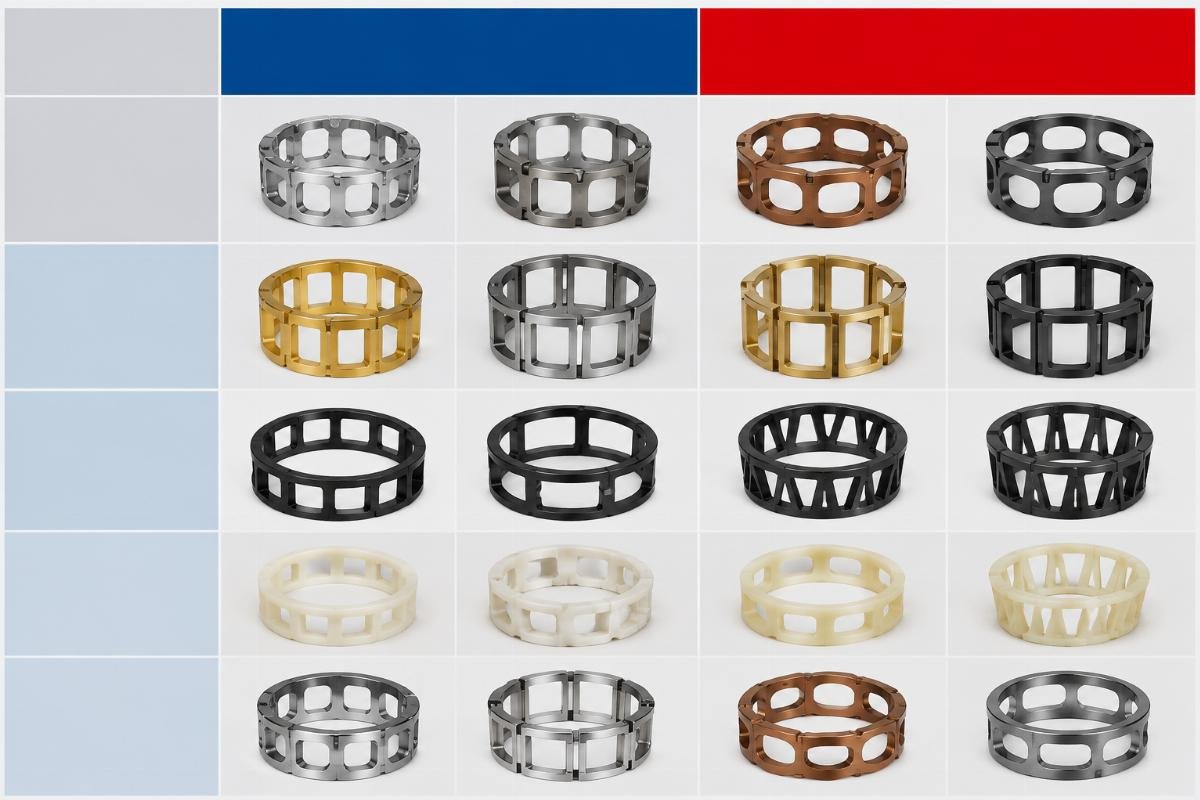
How to Read Cage Material Suffix Codes for FAG and SKF?
The suffix code printed on the bearing outer ring and listed on the packaging is the only reliable way to confirm cage material. Ignoring it is the single most common sourcing mistake in cross-brand replacement.
Both SKF and FAG follow ISO designation conventions, but each brand extends the base code with its own proprietary suffix system for cage materials. The base bearing number tells you the geometry — bore, OD, width, contact angle. The suffix tells you everything else: cage material, internal clearance, seal type, precision class. [NEED_CITE: ISO 15243 bearing designation and suffix conventions]
For SKF, the cage material suffix appears directly after the basic designation:
- J207 — pressed steel cage, window type, steel balls centered
- M — machined brass cage, roller centered (for roller bearings) or ball centered
- MA — machined brass cage, outer ring centered
- MB — machined brass cage, inner ring centered
- P — injection-molded polymer cage, typically glass-fiber reinforced polyamide
- P5 — polymer cage with specific glass-fiber reinforcement grade
For FAG, the system looks similar on the surface but uses different codes:
- J52 — pressed steel cage, window type
- M — machined brass cage (this one overlaps with SKF, which causes confusion)
- TVP — injection-molded polymer cage, glass-fiber reinforced polyamide
- TVP2 — updated polymer cage design with improved guidance
- TV — pressed polymer cage (older designation, still seen in legacy stock)
Notice that the letter M means machined brass in both systems — but only because both brands independently adopted the same convention for brass. For steel and polymer, the codes diverge completely. SKF uses J207 and P; FAG uses J52 and TVP. If you see a bearing marked J52 and assume it matches a J207 specification, you’re making an assumption that could cost you a machine downtime event. [NEED_CITE: FAG bearing suffix code system per Schaeffler technical documentation]
A maintenance team at a paper mill in Southeast Asia was replacing cylindrical roller bearings on a dryer roll. The OEM called for FAG bearings with TVP2 polymer cages. The procurement team found SKF equivalents and ordered them, but specified the M suffix out of habit — thinking brass was always the "better" option. The brass cages changed the bearing’s dynamic behavior at the operating speed, increased friction, and raised operating temperature noticeably. The dryer roll had to be shut down for re-inspection. The fix was straightforward once identified — reorder with the correct polymer suffix — but the downtime cost several times more than the bearings themselves.
When you source through authorized channels, the suffix is printed on the box label, laser-etched on the bearing ring, and listed on the mill certificate. When sourcing through secondary markets, the suffix is your first line of defense against receiving the wrong material. This is exactly why we provide complete cross-reference interchange charts covering SKF, NSK, FAG, TIMKEN, NTN, and KOYO — so buyers can match not just the base number but every suffix detail before placing an order.
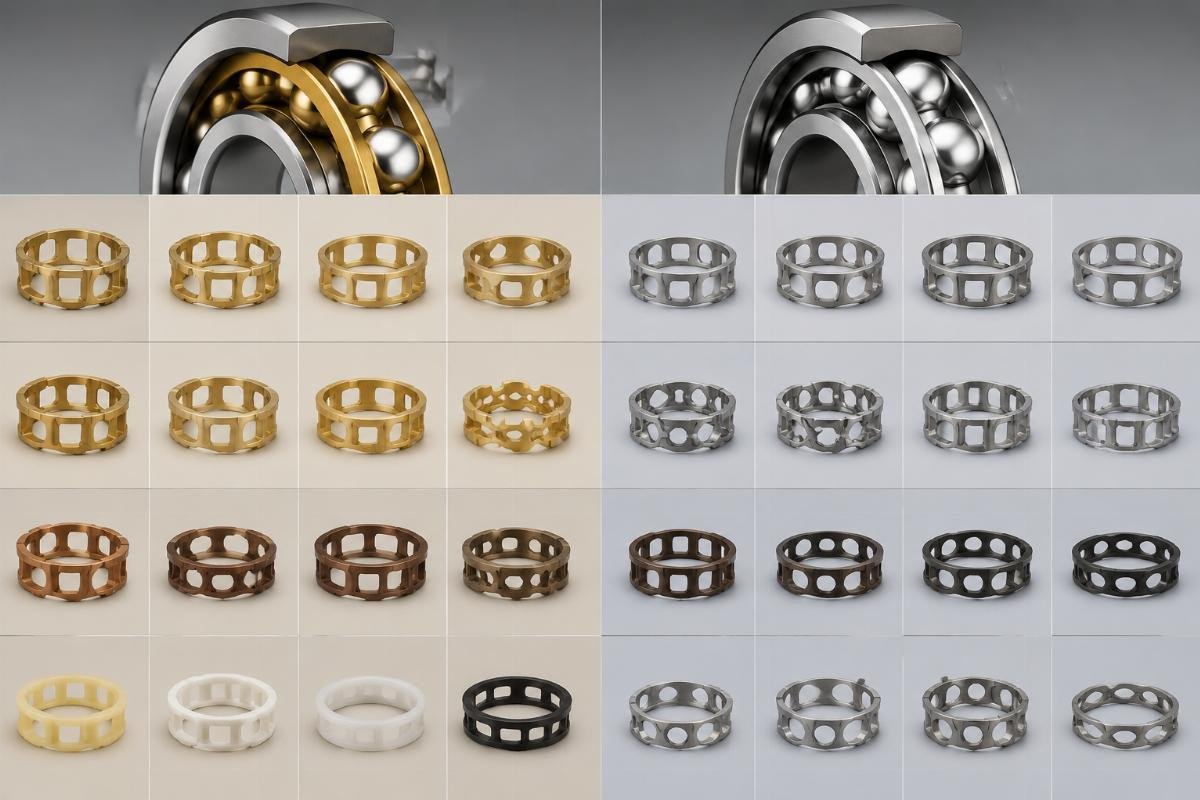
Steel vs Brass vs Polymer Cage: Which Fits Your Application?
There is no universally superior cage material. Each material has distinct thermal limits, speed capabilities, and lubrication requirements that must match your specific operating conditions.
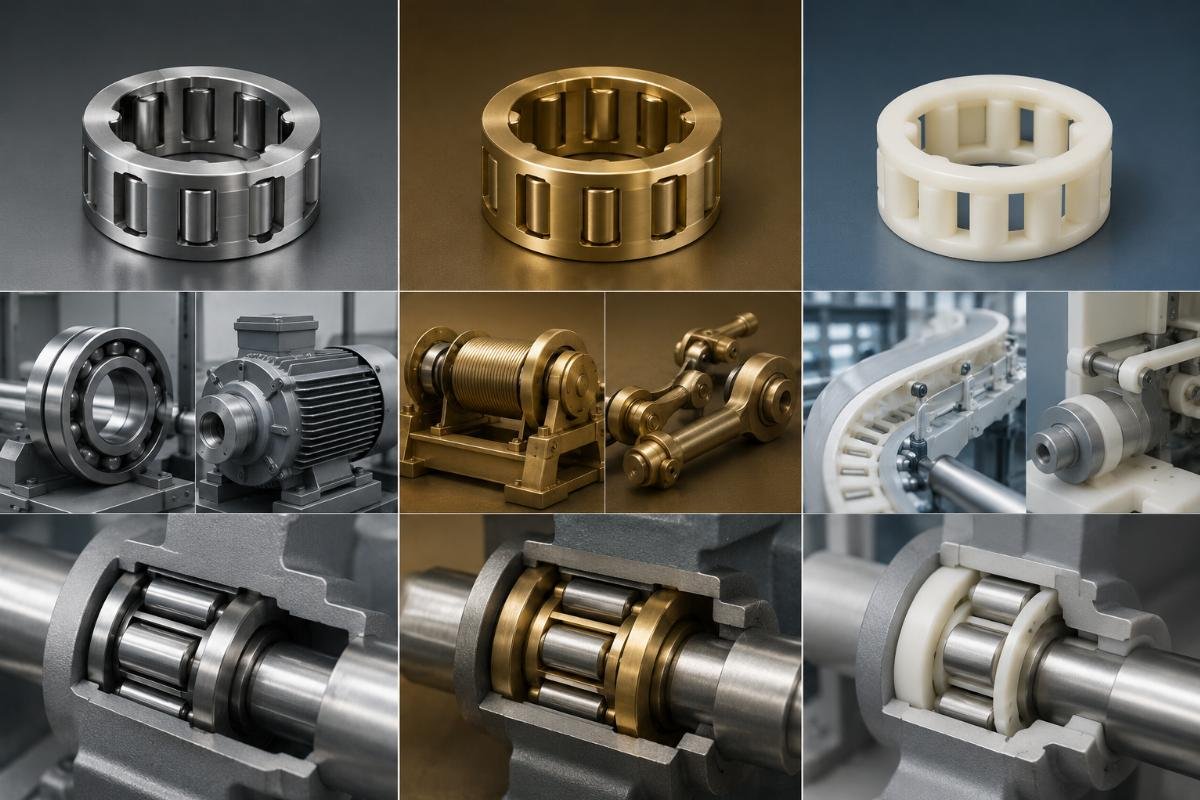
The three mainstream cage materials — pressed steel, machined brass, and polymer — each occupy a specific performance envelope. Choosing incorrectly doesn’t just reduce bearing life; it can cause catastrophic failure modes that damage surrounding components.
Pressed Steel Cages
Pressed steel cages are formed from sheet steel through a stamping process. They are lightweight, economical, and well-suited to high-speed applications where low mass reduces centrifugal forces on the cage pockets. Steel cages operate reliably at temperatures up to approximately 300°C, making them suitable for most general industrial applications. However, steel cages have lower guidance accuracy compared to machined alternatives, and they require adequate lubrication to prevent pocket wear at high speeds. [NEED_CITE: pressed steel cage temperature and speed limits per bearing engineering handbook]
Steel cages are the right choice when: the application runs at high speed with moderate loads, the operating temperature stays below the steel limit, and cost efficiency matters. They are the default for SKF’s general-purpose lines for good reason.
Machined Brass Cages
Machined brass cages are cut from solid brass bar or tube stock. They offer superior guidance accuracy, better tolerance to misalignment, and excellent performance under heavy radial and shock loads. Brass cages are self-lubricating to a degree — the brass alloy retains a thin lubricant film on the contact surfaces, which provides a margin of safety during momentary lubrication starvation. The trade-off is a lower maximum operating temperature, typically around 250°C, and higher weight that increases centrifugal forces at very high speeds. [NEED_CITE: machined brass cage material properties and application guidelines]
Brass cages are the right choice when: the application involves heavy loads, shock loading, or moderate speeds with potential misalignment. Mining conveyors, vibrating screens, and heavy-duty gearboxes are classic brass cage applications.
Polymer Cages
Polymer cages — typically glass-fiber reinforced polyamide (PA66) — are injection-molded to precise geometry. They are the lightest cage option, produce the lowest noise and vibration, and run cooler than metal cages due to lower friction at the cage-rolling element contact points. Polymer cages also tolerate momentary lubrication loss better than steel, as the polymer material does not gall or weld to the rolling elements. The limitation is temperature: standard polyamide cages are limited to approximately 120°C continuous operation, with short-term peaks up to 150°C depending on the specific compound. [NEED_CITE: polymer cage material temperature limits per bearing manufacturer technical data]
Polymer cages are the right choice when: noise and vibration are critical, the operating temperature stays within polymer limits, and the application benefits from low friction and light weight. Electric motors, fans, and precision machine tool spindles are typical polymer cage applications.
Here’s where the counterintuitive part comes in: many buyers automatically specify brass cages, believing them to be the premium option in all scenarios. But in a high-speed, light-load electric motor application, a polymer cage will outperform brass on noise, vibration, and running temperature. The brass cage’s higher mass generates more centrifugal force, and the metal-to-metal contact produces more friction heat. I’ve seen polymer cages extend service life meaningfully in fan applications where brass cages were originally specified — simply because the polymer ran cooler and quieter.
| Factor | Pressed Steel | Machined Brass | Polymer |
|---|---|---|---|
| Temperature resistance | High | Moderate | Limited |
| Speed capability | High | Moderate | High |
| Noise and vibration | Moderate | Moderate | Low |
| Heavy load tolerance | Standard | Enhanced | Standard |
| Lubrication starvation resistance | Vulnerable | Robust | Resistant |
| Weight | Moderate | High | Low |
How to Verify Cage Material on Received Goods?
Physical inspection alone cannot reliably distinguish steel cages from brass cages when both are plated or coated. Verification requires a four-step process: suffix check, visual inspection, documentation cross-reference, and physical testing when in doubt.
This is the step most buyers skip — and it’s where counterfeit or mislabeled products slip through. I’ve seen shipments arrive with correct base part numbers but wrong cage materials, and the difference is not always visible to the naked eye.
Step 1: Verify the suffix on packaging and bearing marking.
The outer box label must show the complete designation including the cage suffix. The bearing itself should have the suffix laser-etched or stamped on the outer ring or end face. Compare this marking against your purchase order. If the PO specifies SKF 6206-2RS1/J207 but the box reads SKF 6206-2RS1, you have a mismatch — the default cage may differ from what you ordered. [NEED_CITE: SKF bearing marking and packaging identification standards]
Step 2: Visual and physical inspection of the cage.
Pressed steel cages have a characteristic silver-gray metallic appearance with visible stamping marks and rivet joints at the pocket connections. Machined brass cages show a golden-yellow color with smooth machined surfaces and no rivets — the cage is typically a single-piece or two-piece machined construction. Polymer cages are dark gray or black with a matte plastic finish and visible molding lines. However, some steel cages receive zinc or phosphate coatings that can alter the surface color, making visual identification alone unreliable.
Step 3: Cross-reference the mill certificate or test report.
Genuine bearings from authorized distributors are accompanied by documentation that lists the complete bearing designation, including suffix codes, batch number, and country of origin. Request this documentation before shipment and verify it upon receipt. If the supplier cannot provide traceable documentation, treat the shipment as high-risk. This is a core part of our authenticity verification service — we confirm that the documentation matches the physical product and traces back to the manufacturer’s production facilities. [NEED_CITE: bearing authenticity verification documentation requirements per industry best practice]
Step 4: Weight comparison and magnet testing.
Brass cages are noticeably heavier than steel cages of the same bearing size. If you have a known genuine reference bearing, a simple weight comparison can reveal discrepancies. A magnet test can also help: steel cages are magnetic, brass cages are not, and polymer cages are not. If the cage is supposed to be brass but a magnet sticks firmly to it, the cage is either steel with a brass-colored coating or outright counterfeit.
A distributor in West Africa received a batch of what was labeled as FAG spherical roller bearings with brass cages. The base numbers were correct, the packaging looked genuine, but during incoming inspection, a warehouse technician noticed the magnet test failed — the cages were magnetic, indicating steel, not brass. Further investigation revealed the suffix code on the bearing rings did not match the box labels. The shipment was intercepted before it reached the end user’s mining operation, where steel cages under heavy shock loads would have failed rapidly.
This is why sourcing through verified authorized channels matters. When we support buyers with cross-brand sourcing across SKF, NSK, FAG, TIMKEN, NTN, and KOYO, the first step is always confirming the complete suffix specification — not just the base number — and the second step is verifying the received goods match that specification through documentation and physical checks.

Conclusion
FAG and SKF cage material systems are not interchangeable by default — suffix codes, default configurations, and material performance envelopes all differ between the two brands.
Cross-brand bearing substitution requires verifying the complete suffix designation, understanding the thermal and speed limits of each cage material, and physically inspecting received goods against purchase specifications. The cost of skipping these steps is measured in machine downtime, not bearing price. Always confirm the cage material before ordering, and always verify it upon receipt.