FAG vs SKF Bearing Precision Class Standards | Wholesale Supplier Cross-Reference
P6 is not P6 when you cross the brand line.
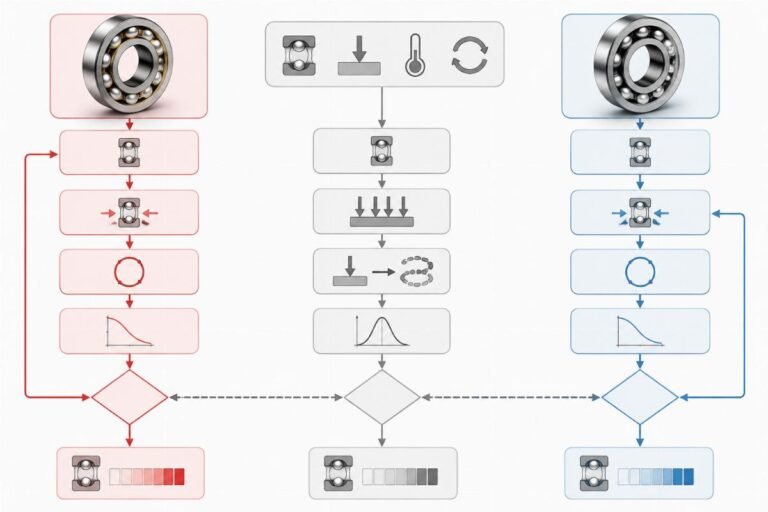
Both FAG and SKF comply with ISO 492 for radial bearings and ISO 3290 for taper rollers, yet the tolerance band centerline each brand targets within the same P-class differs subtly. Ordering a replacement by class suffix alone risks misaligned clearance, unexpected vibration, and premature field failure.
I remember walking the floor at Hannover Messe years ago, standing between two booth rows, watching a buyer from a European paper mill flip between an FAG catalog and an SKF price list. He was swapping a failed spindle bearing and assumed P6 meant P6. The numbers on the tolerance table looked identical at first glance, but when we pulled out a micrometer and compared three sample sets from each brand, the inner ring bore deviation clustered around different midpoints. [NEED_CITE: ISO 492 tolerance band distribution per P-class for radial ball bearings] That single afternoon reshaped how I handle every cross-brand request: never trust the class label alone, always ask for the actual inspection report.

Let’s walk through how the two brands align, where they diverge, and how you can verify specs before placing an order.
What Are the Precision Class Standards for FAG and SKF Bearings?
Both brands anchor their precision grading to the same international framework, but their internal documentation and suffix conventions carry brand-specific fingerprints.
FAG, operating under the Schaeffler Group, structures its radial bearing tolerance classes according to ISO 492 and its taper roller bearings according to ISO 492-2. The standard classes run from Normal (P0) through P6, P5, P4, and P2, with each step tightening the allowable deviation for bore diameter, outside diameter, width, and running accuracy. [NEED_CITE: ISO 492 dimensional and running accuracy tolerance classes for rolling bearings] FAG’s catalog typically lists these as standard suffixes directly on the part number, and the technical tables mirror the ISO boundary values without additional brand-layer modifiers for general-purpose deep groove or spherical roller types.
SKF follows the identical ISO 492 structure for its metric radial bearings and uses the same P-class ladder. However, SKF’s documentation often pairs the P-class with its internal clearance designations (C2 through C5) and vibration class groupings (Z1V1 through Z4V4) in combined tables, which can create the impression that clearance and vibration are bundled into the precision class itself. [NEED_CITE: ISO 492 vs ABEC 1-9 equivalence chart for radial bearing precision] They are not. Clearance is governed by ISO 5753, and vibration by ISO 15242. The P-class only controls dimensional and running accuracy.
For buyers working with American-originated equipment or OEM drawings that reference ABEC ratings, both brands publish ABEC equivalence tables. ABEC 1 roughly maps to P0, ABEC 3 to P6, ABEC 5 to P5, ABEC 7 to P4, and ABEC 9 to P2. [NEED_CITE: ABMA ABEC 1-9 to ISO P-class cross-reference for radial bearings] The mapping is directional, not exact, because ABEC and ISO define slightly different sets of controlled parameters.
Here is a simplified cross-reference matrix:
| ISO Class | ABEC Equivalent | FAG Suffix | SKF Suffix | Governing Standard |
|---|---|---|---|---|
| Normal | ABEC 1 | (none) | (none) | ISO 492 |
| P6 | ABEC 3 | P6 | P6 | ISO 492 |
| P5 | ABEC 5 | P5 | P5 | ISO 492 |
| P4 | ABEC 7 | P4 | P4 | ISO 492 |
| P2 | ABEC 9 | P2 | P2 | ISO 492 |
The suffixes look interchangeable. The tolerance tables behind them do not always overlap perfectly.

How Do FAG and SKF Tolerance Ranges Differ Within the Same P-Class?
The ISO standard defines the outer boundary of the tolerance band, but each brand positions its production target at a different point inside that band.
Think of the tolerance band as a corridor. ISO 492 tells you the walls. FAG tends to aim its average production values toward one side of the corridor, while SKF aims toward the other. Both are inside the corridor, both are compliant, but a shaft designed to sit snugly against the FAG midpoint will feel loose when an SKF bearing of the same P-class is dropped in.
This becomes critical in interference-fit applications. Consider a deep groove ball bearing in P5 class for a machine tool spindle. The inner ring bore tolerance for a 50 mm bore might span a range of a few microns. If the FAG units you have been running cluster at the tighter end of that range, and you source an SKF P5 replacement that clusters at the wider end, the interference fit on the shaft changes. The bearing seats differently. Internal clearance shifts. Vibration behavior changes. [NEED_CITE: effect of tolerance band centerline shift on interference fit and internal clearance in spindle bearings]
I saw this play out at a European automotive transmission plant. They had been running FAG P6-class cylindrical roller bearings in a gear test rig for years. When supply tightened, the maintenance team ordered SKF equivalents in the same P6 class from a regional distributor. The bearings arrived with full certificates. The first set went into the rig. Within a short run cycle, the vibration signature climbed noticeably above the baseline alarm threshold. The team pulled the bearing, measured the inner ring bore, and found it sitting at the opposite end of the P6 corridor from what the FAG units had delivered. The fit was looser than the rig’s shaft tolerance expected. [NEED_CITE: case study on vibration deviation caused by tolerance band centerline mismatch in cross-brand bearing replacement]
The same logic applies in reverse. A spindle designed around the SKF midpoint will behave differently if an FAG unit lands at the other extreme.
This is not a quality defect. It is a statistical reality of high-volume manufacturing. Each brand optimizes its grinding and lapping processes around its own historical customer base and equipment ecosystem. The difference only surfaces when you mix brands inside a tightly specified assembly.

How to Verify Bearing Precision When Cross-Referencing Brands?
Never accept a class suffix as the sole verification. Request the batch-level inspection report and cross-check three parameters: dimensional tolerance, radial internal clearance, and vibration grade.
Here is the verification sequence I follow for every cross-brand sourcing request:
Step 1: Confirm the ISO class and clearance class on the drawing.
Pull the OEM specification sheet. Identify the ISO P-class, the radial internal clearance class (C2, C3, C4, etc.), and any vibration or noise grade requirement. [NEED_CITE: ISO 5753 radial internal clearance classes for rolling bearings] Write these three items down as your baseline. Do not rely on the part number suffix alone, because suffix conventions vary between brands.
Step 2: Request the batch inspection report from the supplier.
Ask for a certificate or test report that shows actual measured values for inner ring bore, outer ring OD, width, and radial internal clearance for the specific batch being shipped. A generic certificate that only states "conforms to P6" without measured values is not sufficient for precision-critical applications. [NEED_CITE: requirements for batch-level inspection reports in industrial bearing procurement]
Step 3: Compare the measured values against your existing brand’s historical data.
If you have been running FAG P6 bearings and know their typical bore deviation range from past inspection reports, overlay the SKF batch data on the same chart. If the SKF values cluster on the opposite side of the tolerance band, flag it before installation.
Step 4: Verify the vibration grade independently if the application is speed-sensitive.
For high-speed spindles, fans, or electric motors, ask for vibration test data measured per ISO 15242. The vibration grade (Z1V1 through Z4V4) is separate from the P-class and must be confirmed independently. [NEED_CITE: ISO 15242 vibration measurement methods for rolling bearings]
Step 5: Confirm authenticity through official channels.
Counterfeit bearings are a persistent risk in cross-brand sourcing. Verify the supplier’s authorization status, check the packaging for laser-etched branding, and use the brand’s official QR code or app-based verification tool where available. [NEED_CITE: anti-counterfeit verification methods for SKF and FAG bearings]
A Middle East steel mill operator once called me after a continuous caster roll bearing failed repeatedly. They had been buying SKF P5-class spherical roller bearings and switched to an FAG equivalent sourced through a trading company. The FAG bearings were genuine, but the trading company had supplied a batch with C4 clearance instead of the C3 the mill required. The larger clearance caused excessive roller skidding under the heavy radial load, and the bearings overheated within weeks. The inspection report would have caught this instantly. Nobody had asked for one.

What Happens If Precision Class Is Mismatched in Application?
A precision mismatch does not always cause immediate failure. It often causes slow, expensive degradation that masquerades as a lubrication problem or a load issue.
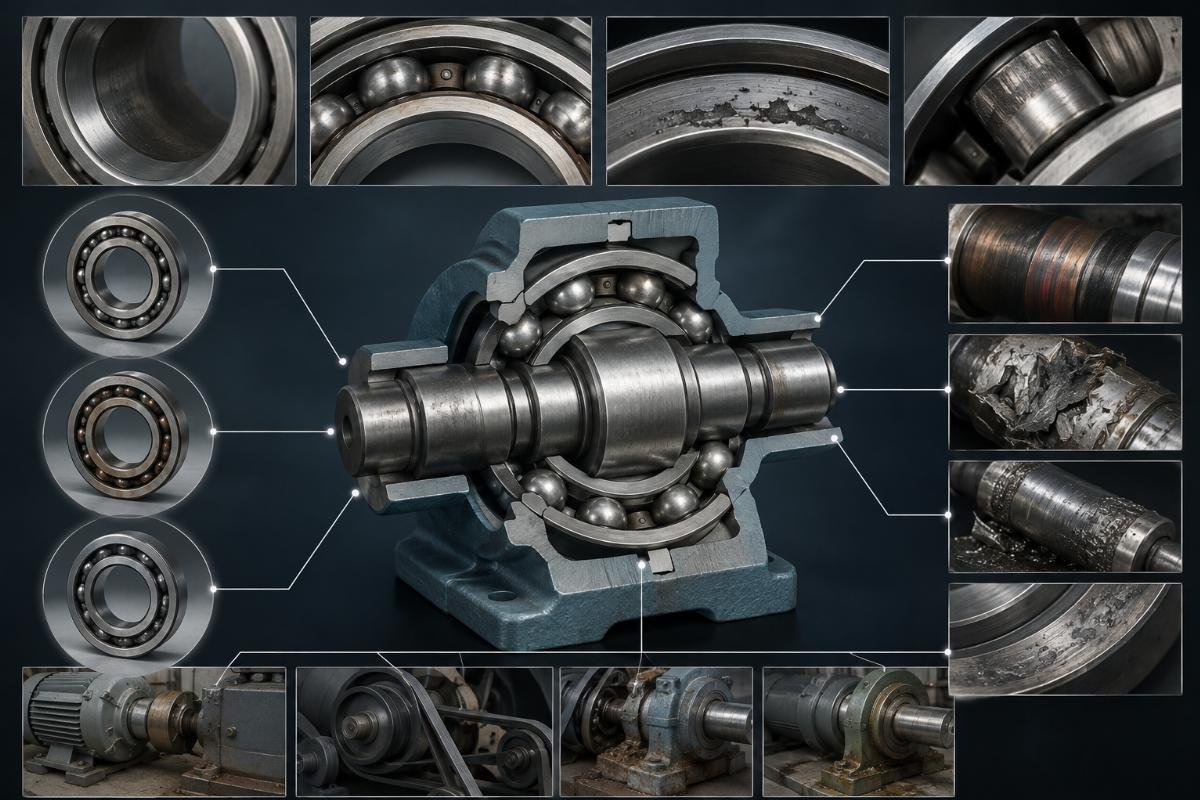
When the tolerance band centerline is off, the bearing’s internal geometry changes. Rolling elements do not share the load evenly. One or two rollers carry disproportionate stress. The cage experiences uneven guidance forces. Lubricant film thickness fluctuates. Heat builds up in localized zones. [NEED_CITE: failure mode analysis for bearing internal clearance mismatch under heavy radial load]
In a wind turbine gearbox, this plays out over months rather than days. A European wind farm operator replaced a set of planetary gear bearings with a cross-brand equivalent that matched the P5 class on paper but carried a different clearance class than the original specification. The turbine ran fine during commissioning. Six months later, oil analysis showed elevated iron particle counts. A year in, the gearbox was pulled for inspection. The planetary bearings showed early-stage spalling on the inner ring raceway, concentrated on one side. The root cause was not the P-class. It was the clearance mismatch, which had allowed uneven load distribution under the variable torque profile of the wind load cycle. [NEED_CITE: wind turbine gearbox bearing failure analysis linked to internal clearance deviation]
In high-speed machining centers, the consequence is more immediate. A spindle bearing with the wrong internal clearance will show elevated vibration at operating speed, poor surface finish on the workpiece, and accelerated wear on the spindle taper interface. The operator blames the tooling. The real issue sits inside the bearing housing.
In electric motors, a precision mismatch can shift the rotor’s magnetic air gap, increasing cogging torque, reducing efficiency, and generating audible noise that fails end-user acceptance tests.
The cost of a precision mismatch is never just the bearing. It is the downtime, the rework, the scrapped production, and the lost credibility with the end customer.
Conclusion
Precision class labels are necessary but not sufficient for cross-brand bearing interchange. Both FAG and SKF operate within the same ISO framework, but their production centerlines inside the tolerance band differ. Always verify dimensional tolerance, radial internal clearance, and vibration grade against batch-level inspection reports before installing a cross-brand replacement. The bearing itself is a small component. The cost of getting it wrong is never small.