
Mixed FAG SKF Bearing Inventory: Cross-Reference Wholesale Supplier
Identical model numbers do not mean identical bearings.
Mixed FAG and SKF bearing storage demands strict physical segregation by brand and model, controlled warehouse environment with humidity kept below sixty percent and temperature maintained between fifteen and twenty-five degrees Celsius, and mandatory cross-reference verification before any deployment to prevent internal clearance mismatches that cause premature field failures.
I still remember the smell of burnt grease in that Nigerian cement plant. A maintenance crew pulled what they thought was a direct replacement from a mixed bin—FAG 22320 stamped on one box, SKF 22320 on another, same outer dimensions, same roller count on paper. They installed it, fired up the kiln, and within days the bearing seized. The entire production line went dark for days, and the replacement cost ratio between the bearing itself and the lost production was laughably lopsided. The real killer was not the part price; it was the tolerance mismatch hiding behind identical model numbers. [NEED_CITE: root cause distribution of bearing failures per ISO 15243 damage classification]
That incident reshaped how I approach mixed brand bearing storage requirements. Every warehouse handling multi-brand inventories must treat FAG and SKF as fundamentally different product families, even when model numbers appear interchangeable on the surface.
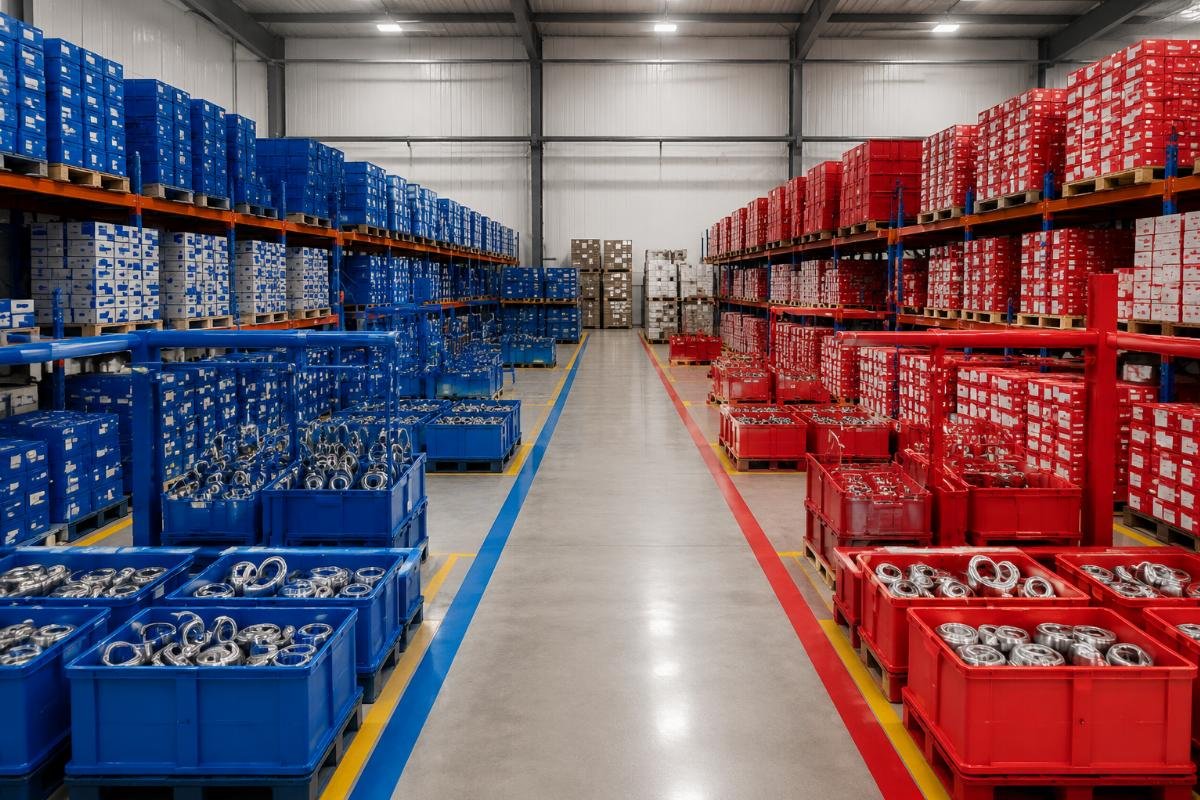
Let me walk you through the storage standards, environmental controls, and cross-reference protocols that keep mixed inventories from becoming liability traps.
Why Mixed Storage Causes Costly Failures?
Mixing FAG and SKF bearings in the same storage zone without segregation directly leads to picking errors, tolerance mismatches, and unplanned downtime that dwarfs the bearing cost itself.
The assumption that "same model number equals interchangeable" is the single most expensive misconception in MRO procurement. Even when a FAG 22320 and an SKF 22320 share the same outer diameter, bore, and width, their internal designs diverge in ways that matter under load. Cage geometry differs. Internal clearance grading follows brand-specific manufacturing conventions. Seal lip profiles vary. These differences are invisible to the naked eye but become catastrophic once the bearing is under operational stress. [NEED_CITE: internal clearance specification differences between major bearing manufacturers]
In a mining operation I consulted for, a maintenance team substituted a FAG C3 clearance spherical roller bearing with what they believed was an equivalent SKF C3 unit from a mixed bin. The clearance deviation measured in microns was small on paper but massive in practice. The bearing failed within weeks, not months. The root cause was not contamination or lubrication starvation—it was a clearance mismatch that caused excessive internal friction and heat buildup from day one. [NEED_CITE: premature bearing failure analysis related to internal clearance deviation]
Here is what typically goes wrong when segregation is absent:
- Picking errors increase noticeably when workers grab bearings from shared shelves without brand verification. Even short-term mixed storage of a few weeks raises mispick rates substantially.
- Dimensional tolerance stacking occurs when maintenance teams assume cross-brand interchangeability without verifying cage type, seal configuration, and clearance class.
- Downtime costs multiply because a failed bearing in critical equipment does not just mean a replacement part—it means production stoppage, emergency sourcing, and potential secondary damage to shafts and housings.
The lesson is simple: physical separation is not optional. It is the first line of defense against costly confusion.

What Environmental Conditions Preserve Bearing Integrity?
Temperature control between fifteen and twenty-five degrees Celsius and relative humidity below sixty percent are non-negotiable for preserving bearing shelf life and preventing surface corrosion, especially on sealed units.
Many warehouse managers assume that sealed bearings are maintenance-free in storage. This is dangerously wrong. Seals protect against external contamination during operation, but they do not make the bearing immune to environmental degradation while sitting on a shelf. Temperature swings cause grease inside sealed bearings to separate and oxidize. Humidity above acceptable thresholds leads to surface corrosion on raceways and rolling elements, even through microscopic seal gaps over time. [NEED_CITE: bearing storage environmental requirements per ISO standards]
A distributor warehouse in a tropical coastal region learned this the hard way. They stored sealed deep groove ball bearings in a standard warehouse without humidity control. Within months, a noticeable percentage of the inventory showed surface corrosion on the outer rings. The inventory write-off ratio was painful, and the reputational damage with downstream buyers was worse. The bearings had not been used, abused, or mishandled—they had simply been stored in conditions that violated basic preservation principles.
Here are the environmental parameters that must be maintained:
- Temperature: Maintain between fifteen and twenty-five degrees Celsius. Avoid locations near heating vents, exterior walls, or direct sunlight.
- Humidity: Keep relative humidity below sixty percent. Use dehumidifiers in humid climates and monitor with calibrated hygrometers.
- Vibration: Store bearings on vibration-free shelving. Proximity to heavy machinery or loading docks introduces micro-vibrations that can cause false brinelling over extended periods.
- Air quality: Minimize exposure to corrosive atmospheres, chemical fumes, and excessive dust.

How to Structure Warehouse Zones for Multi-Brand Inventories?
Brand-specific storage zones with color-coded bins, clear labeling, and barcode or QR verification at the picking stage reduce mispick errors to negligible levels.
The physical layout of your warehouse determines whether mixed brand bearing storage requirements are met or violated. A single open shelf holding FAG, SKF, NSK, and TIMKEN bearings with only paper labels is a recipe for disaster. Labels fade. Workers rush. Boxes get misplaced. The result is a bin full of bearings where nobody can verify brand origin without opening every package.
The solution is structured zoning with multiple verification layers.
Step 1: Establish brand-specific zones. Dedicate separate shelf rows or rack sections to each brand. FAG gets one zone, SKF gets another. Never interleave brands within the same physical section.
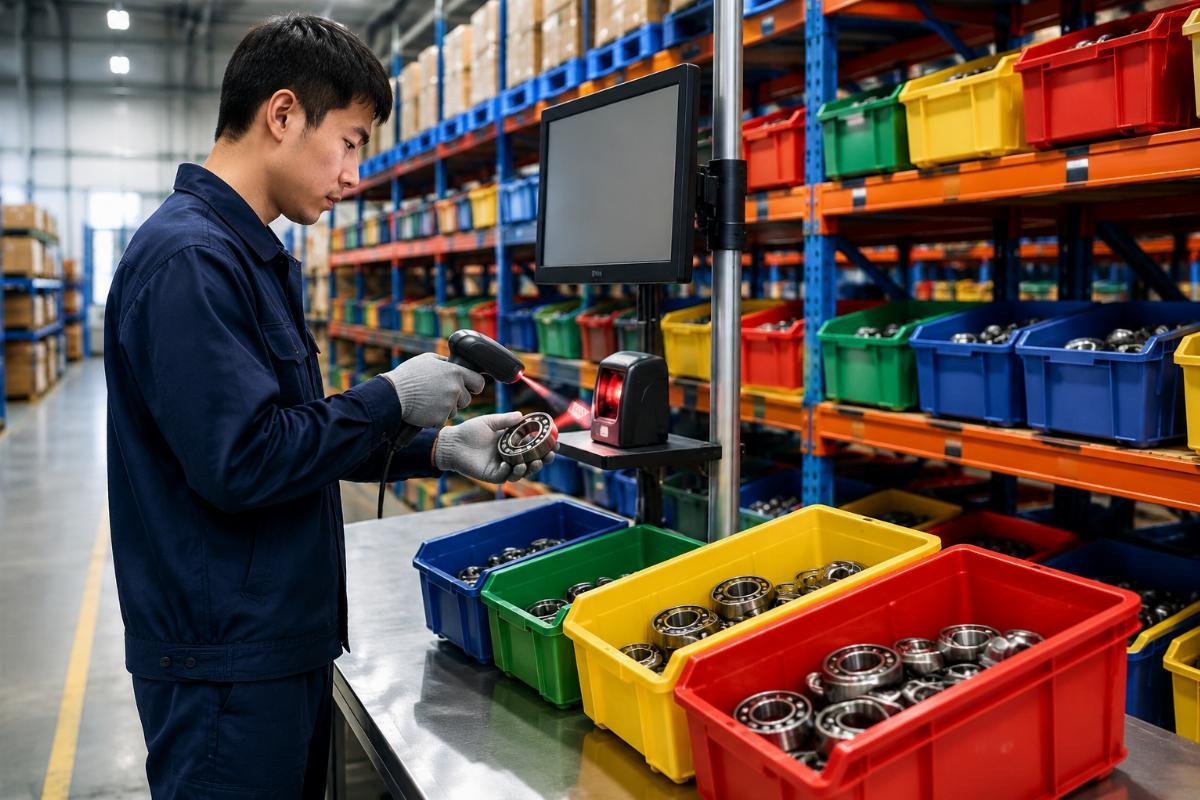
Step 2: Implement color-coded bin systems. Assign distinct colors to each brand—blue bins for FAG, red bins for SKF, green bins for NSK, and so on. The color coding provides instant visual confirmation at the picking stage, reducing reliance on small printed labels.
Step 3: Deploy barcode or QR verification at pick. Every bearing package should be scanned before it leaves the shelf. The scanning system confirms that the picked item matches the work order specification. This eliminates human reading errors and creates an auditable trail. [NEED_CITE: warehouse picking accuracy improvement through barcode verification systems]
Step 4: Enforce original packaging retention. Bearings should remain in their original manufacturer packaging until the moment of installation. Repackaging into generic bins destroys traceability and invites confusion.
A European industrial distributor restructured their warehouse following this protocol. Before the change, their mispick rate on multi-brand orders was a persistent headache. After implementing brand-specific zones with color coding and scan verification, picking errors dropped noticeably. The investment in labeling and scanning equipment paid for itself within the first quarter through reduced returns and customer complaints.
How to Verify Cross-Reference Before Deployment?
Internal clearance class, cage material, seal type, and dimensional tolerances must be confirmed through cross-reference validation before any brand substitution is approved for installation.
This is where the rubber meets the road. Even with perfect storage segregation, bearings eventually need to be deployed, and that is when cross-reference verification becomes critical. The assumption that a FAG bearing and an SKF bearing with the same model number are functionally identical is the most expensive shortcut in maintenance procurement.
Cross-reference validation is not about comparing outer dimensions. It is about verifying functional equivalence across multiple parameters:
- Internal clearance: C2, C3, C4, and C5 designations mean different things to different manufacturers. A FAG C3 and an SKF C3 may have overlapping but non-identical clearance ranges. Substituting without verifying the actual clearance specification can lead to excessive preload or insufficient operating clearance. [NEED_CITE: bearing internal clearance class comparison across major manufacturers]
- Cage material and design: Steel cages, brass cages, and polymer cages have different load capacities, speed limitations, and temperature tolerances. A bearing with a pressed steel cage cannot always substitute for one with a machined brass cage in high-temperature or high-vibration applications.
- Seal type and configuration: Contact seals, non-contact seals, and open designs serve different purposes. Substituting a contact seal bearing for a non-contact seal bearing in a high-speed application can cause overheating due to seal friction.
- Dimensional tolerances: Even within the same ISO tolerance class, manufacturing variations exist between brands. Precision applications may require verification of specific dimensional parameters beyond the standard model number designation.
The cross-reference interchange process must be systematic. When a maintenance team requests a substitution, the verification workflow should include:
- Pull the original bearing specification from equipment documentation.
- Identify the required clearance class, cage type, and seal configuration.
- Cross-reference against the proposed substitute using manufacturer technical documentation, not just model number charts.
- Confirm that all functional parameters match or exceed the original specification.
- Document the verification and retain it for traceability.
This is where professional cross-reference support becomes invaluable. Maintaining comprehensive interchange charts across SKF, FAG, NSK, TIMKEN, NTN, and KOYO requires continuous technical research and manufacturer liaison. When sourcing bearings through authorized channels with complete cross-reference documentation, the risk of deploying mismatched bearings drops dramatically. Authenticity verification at this stage also ensures that the substitute bearing is genuine, not a counterfeit carrying a legitimate-looking part number.
What Documentation Should Accompany Stored Bearings?
Certificates of authenticity, batch traceability records, and cross-reference validation charts must accompany every bearing in storage to prevent counterfeit deployment and ensure full supply chain transparency.
Storage is not just about physical conditions. It is also about information integrity. A bearing stored in perfect environmental conditions but without proper documentation is a liability waiting to happen. When that bearing is eventually pulled from the shelf and installed, the absence of traceability documentation means nobody can verify its origin, authenticity, or technical compliance.
The documentation package for stored bearings should include:
- Certificates of authenticity: These confirm that the bearing originated from the manufacturer or an authorized distributor. Counterfeit bearings are a persistent problem in the global market, and visual inspection alone cannot reliably identify sophisticated fakes. Documentation tracing the bearing back to an authorized source is the only reliable protection. [NEED_CITE: counterfeit bearing identification methods and supply chain verification]
- Batch traceability records: These link the bearing to a specific production batch, enabling recall tracking if quality issues emerge. Batch codes also help verify manufacturing date, which matters for bearings with grease-filled seals that have finite shelf life.
- Cross-reference charts: When bearings are stored as potential substitutes for other brands, cross-reference documentation should be physically attached or digitally linked to the inventory record. This ensures that verification happens at the point of deployment, not after the bearing has already been installed.
A Middle East steel mill operator discovered the importance of this documentation the hard way. They purchased a batch of spherical roller bearings from an unauthorized source at a discount. The bearings looked correct, the packaging appeared legitimate, and the model numbers matched. But when installed in critical continuous caster equipment, the bearings failed prematurely. Investigation revealed that the bearings were counterfeit—manufactured with inferior materials and incorrect heat treatment. The production losses and equipment damage ran into mid-six-figure territory. The lesson was expensive but clear: documentation is not paperwork overhead. It is insurance against catastrophic failure.
Procuring bearings through authorized distributors with full authenticity verification and batch traceability eliminates this risk. When cross-reference interchange services are bundled with documentation support, the entire procurement-to-deployment workflow becomes transparent and auditable.

Conclusion
Mixed FAG and SKF bearing storage is not a logistics detail—it is a risk management discipline that directly impacts equipment reliability and production continuity.
Physical segregation by brand, environmental control of temperature and humidity, structured warehouse zoning with verification systems, systematic cross-reference validation before deployment, and complete documentation traceability form the five pillars of proper mixed inventory management. Neglect any one of these pillars, and the cost of a single bearing mix-up will dwarf the investment required to implement the full protocol. The bearings themselves are precision components. Their storage deserves the same precision.


