
Vibration Analysis for Genuine FAG & SKF Bearings: Wholesale Supplier Support
Same model number does not mean same vibration signature.
Even when FAG and SKF bearings share an interchangeable model number, internal geometric tolerances, clearance grading, and raceway contour differences produce distinct vibration responses. Replacing one brand with the other without vibration analysis risks abnormal noise, elevated vibration readings, and premature field failure. Vibration analysis for FAG and SKF bearings must precede any cross-reference swap to confirm spectral compatibility, clearance alignment, and baseline matching under actual operating loads.
I still remember a rotary kiln job at a cement plant in Riyadh. The maintenance team had swapped out a batch of FAG spherical roller bearings using the exact OEM model number. Within weeks, the overall vibration velocity kept climbing past ISO 10816 Zone C thresholds. They assumed the bearings were defective. After pulling the FFT envelope spectra on-site, the inner race fault frequency (BPFI) showed a clear harmonic pattern that did not match the baseline they had recorded under the previous SKF set. The root cause was not bearing quality — it was that the kiln’s load profile had shifted after a refractory upgrade, and the internal clearance class required for the new operating temperature no longer matched the original specification. Vibration analysis for FAG and SKF bearings would have caught this before installation.
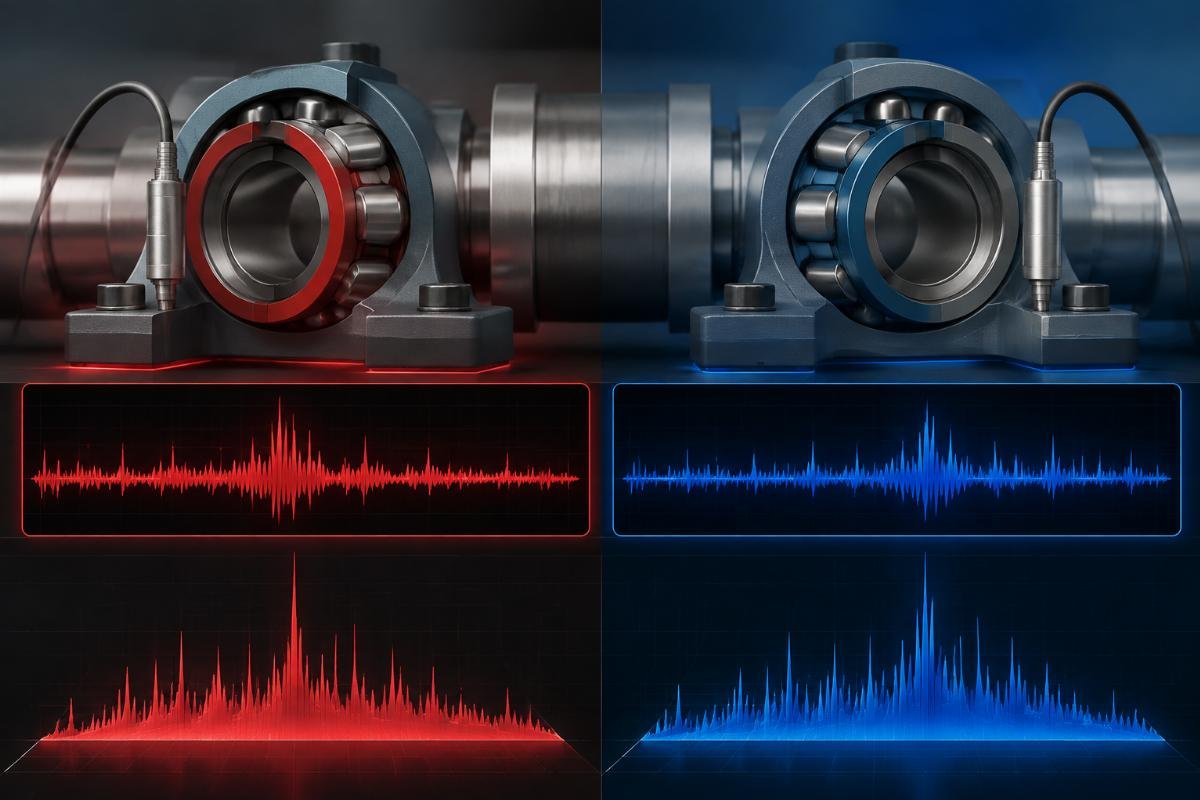
This is the kind of field reality that makes vibration analysis for FAG and SKF bearings a non-negotiable step in any cross-brand replacement program.
Why Do FAG and SKF Bearings Show Different Vibration Signatures Even at Same Model Number?
The answer lies in internal geometry tolerance bands, clearance classification systems, and raceway profiling — not in the external dimensions printed on the box.
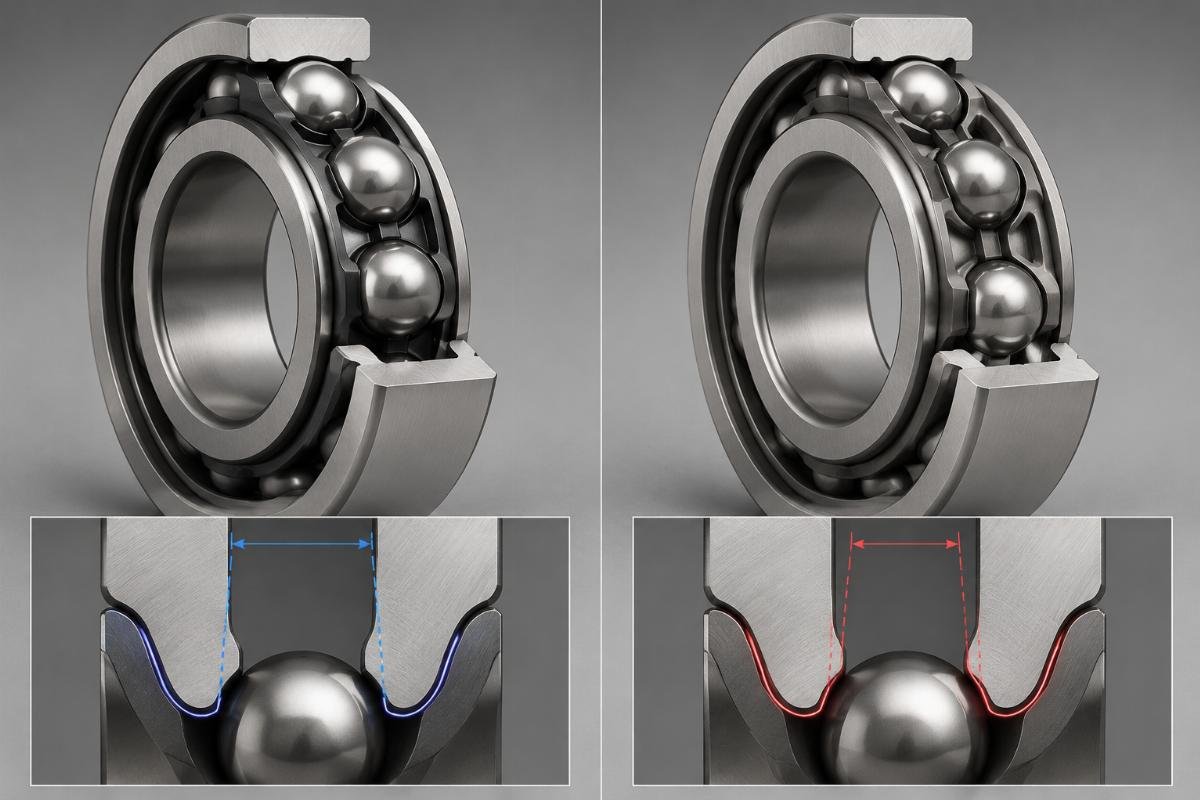
When a maintenance buyer requests a direct FAG-to-SKF cross-reference, the model number matches on paper: same bore, same outside diameter, same width. What does not match is the micro-geometry inside. Each manufacturer applies its own tolerance distribution to rolling element diameter consistency, raceway groove curvature radius, and cage pocket clearance. These differences are well within ISO 492 dimensional standards, yet they produce measurably different vibration excitation patterns when the bearing runs under load [NEED_CITE: influence of internal geometry on bearing vibration excitation per ISO 15243 damage categories].
Two specific factors dominate the vibration signature gap:
-
Clearance grading philosophy. FAG and SKF both offer C2, C3, and C4 clearance groups, but the actual tolerance band center and spread differ slightly between manufacturers. A C3 clearance from one brand may sit at the upper boundary of the other brand’s C3 range. Under thermal expansion in a high-temperature fan application, this shift changes the contact angle and alters the ball pass frequency outer race (BPFO) amplitude noticeably.
-
Raceway contour and surface texture. The superfinishing process and final raceway waviness profile vary by manufacturer. Even when both brands meet the same P5 precision class, the high-frequency vibration envelope in the 1–5 kHz range can differ meaningfully, affecting how early-stage defect signals appear in the spectrum [NEED_CITE: raceway surface finish influence on bearing vibration signature per ISO 10816 severity evaluation].
| Parameter | FAG Typical Range | SKF Typical Range | Field Impact |
|---|---|---|---|
| Internal clearance tolerance band center | Mid-to-upper within grade | Mid-to-lower within grade | Contact angle shift under thermal load |
| Raceway waviness profile | Manufacturer-specific superfinish | Manufacturer-specific superfinish | High-frequency envelope amplitude difference |
| Cage pocket clearance | Controlled per design spec | Controlled per design spec | Retainer frequency (FTF) amplitude variation |
| Rolling element diameter consistency | Within P5/P6 class limits | Within P5/P6 class limits | Ball spin frequency (BSF) harmonic distribution |
A distributor in the Middle East once supplied a full order of FAG deep groove ball bearings as a direct cross-reference for an existing SKF installation on a high-speed fan. The customer ran the equipment and immediately flagged abnormal noise. Vibration analysis for FAG and SKF bearings revealed that the BPFO amplitude was noticeably higher with the FAG set — not because of a defect, but because the raceway contour produced a different contact stress distribution at that specific speed. The fix was not to reject the bearings but to re-baseline the vibration acceptance criteria for the new brand.
How to Perform Vibration Analysis Before Cross-Referencing FAG and SKF Bearings?
Start with the existing baseline, not the replacement bearing.
The most common mistake in cross-brand interchange is measuring vibration only after the new bearing is installed and running. By then, if the signature does not match, the equipment has already been exposed to potentially harmful resonance conditions. A structured vibration analysis for FAG and SKF bearings should follow a defined sequence before any physical swap takes place [NEED_CITE: field vibration baseline acquisition methodology per Vibration Institute best practices].
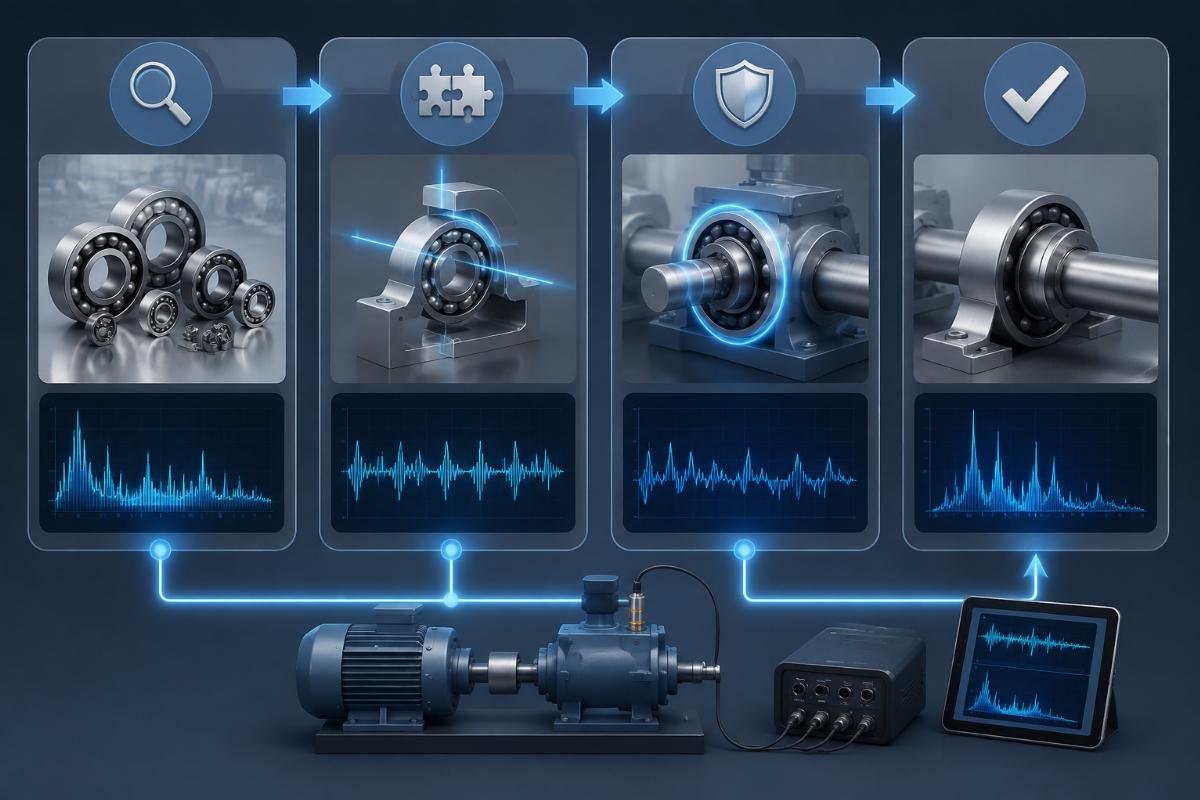
The process works in four ordered steps:
-
Capture the current vibration baseline under stable operating conditions. Record overall vibration velocity (per ISO 10816) and collect FFT envelope spectra at the bearing housing. Document the dominant fault frequencies — BPFO, BPFI, BSF, and FTF — along with their harmonic amplitudes. This baseline represents the vibration signature the machine has been running against, regardless of which brand is currently installed.
-
Obtain the vibration specification data for the proposed replacement bearing. Request the manufacturer’s vibration quality grade documentation (e.g., P6 or P5 class vibration limits). Compare the internal clearance class of the proposed FAG or SKF bearing against the currently installed unit. Confirm that the clearance group (C2, CN, C3, C4) matches or is functionally equivalent under the actual operating temperature range [NEED_CITE: bearing clearance selection guidance per ISO 5753].
-
Overlay the spectral signatures and assess compatibility. If the proposed replacement bearing’s expected fault frequency amplitudes fall within the same order of magnitude as the existing baseline, the swap is likely compatible. If the new bearing’s specification indicates a noticeably different internal geometry that would shift contact angles or cage dynamics, flag this for further review before installation.
-
Conduct a controlled trial run with continuous vibration monitoring. Install the replacement bearing and run the equipment under normal load. Capture vibration data at startup, at thermal stabilization, and after extended operation. Compare all three data points against the original baseline. Any sustained deviation beyond ISO 10816 Zone B thresholds requires investigation before the bearing is approved for long-term service.
A maintenance team at a mining crusher operation in Central Asia skipped Step 1 entirely. They replaced a set of SKF tapered roller bearings with FAG equivalents based solely on model number cross-reference. Within a short operating period, the gearbox developed a pronounced whine. Vibration analysis for FAG and SKF bearings showed that the BSF harmonics had shifted significantly because the roller profile and internal clearance interaction differed between the two brands under the heavy shock-load conditions of the crusher. The entire set had to be pulled and replaced — a cost several times the savings they expected from the cross-reference.
What Are the Common Mistakes When Replacing Bearings Without Vibration Matching?
Assuming model number interchange equals operational interchange is the single most expensive error in cross-brand bearing replacement.
The mistakes cluster into three recurring patterns, each of which I have witnessed repeatedly across field service calls in the Middle East, Africa, and Central Asia.
Mistake one: ignoring operating condition changes between the original installation and the replacement date. Machines age. Loads shift. Refractory linings get upgraded. Motor replacements change speed profiles. The vibration baseline that was acceptable years ago may no longer apply. When a buyer requests a direct brand swap without accounting for these changes, the replacement bearing — whether FAG or SKF — is being asked to perform under conditions it was not selected for. Vibration analysis for FAG and SKF bearings under the current actual conditions would reveal the mismatch before installation [NEED_CITE: root cause distribution of premature bearing failures per ISO 15243 damage mechanism categories].
Mistake two: treating vibration exceedance as a bearing quality issue rather than a selection issue. When vibration levels spike after a brand swap, the immediate assumption is often that the replacement bearings are counterfeit or defective. In reality, the vibration signature simply does not match the machine’s current dynamic environment. I have seen entire batches of genuine FAG bearings returned by customers who later discovered, after proper spectral analysis, that the issue was a clearance class mismatch — not a quality failure.
Mistake three: failing to establish a new baseline after the swap. Even when the replacement bearing performs acceptably, skipping the post-installation baseline update means the next maintenance cycle starts without reference data. This compounds the problem over time, as each successive swap drifts further from any documented vibration standard.
| Mistake Pattern | Typical Symptom | Actual Root Cause | Corrective Action |
|---|---|---|---|
| Ignoring condition changes | Vibration rises steadily after swap | Load or thermal profile no longer matches original clearance selection | Re-evaluate clearance class under current conditions |
| Blaming bearing quality | Immediate rejection of genuine bearings | Spectral mismatch due to internal geometry differences | Perform FFT comparison before installation |
| Skipping post-swap baseline | No reference data for next maintenance cycle | Process gap in documentation procedure | Record vibration data at startup, thermal stabilization, and extended run |
A steel mill in the Gulf region experienced repeated complaints after a distributor cross-referenced their SKF spherical roller bearings to FAG without any vibration verification. The equipment ran for a short period before developing abnormal noise. The mill’s maintenance manager assumed the FAG bearings were substandard. After conducting proper vibration analysis for FAG and SKF bearings on-site, the real issue was identified: the original SKF bearings had been running with a clearance that was no longer appropriate for the mill’s updated process temperatures, and the FAG replacement — while dimensionally identical — responded differently to the thermal expansion because of its clearance tolerance band position. The solution was to select a different clearance class, not a different brand.

How to Build a Reliable Cross-Reference Process with Vibration Verification?
A disciplined four-gate verification process turns cross-brand interchange from a guessing game into a repeatable engineering decision.
The goal is to create a workflow where vibration analysis for FAG and SKF bearings is embedded into the cross-reference procedure itself — not treated as an afterthought when something goes wrong. This requires coordination between the technical team, the procurement team, and the bearing supplier.
Gate one: model cross-reference validation with internal geometry check. Before any bearing is sourced, confirm that the proposed FAG or SKF replacement matches not only the external dimensions but also the internal clearance class, contact angle (for angular contact types), and roller profile category (for spherical and tapered roller types). Request the manufacturer’s technical documentation confirming these parameters. A reliable bearing supplier with cross-reference expertise can provide complete interchange charts covering SKF, FAG, NSK, TIMKEN, NTN, and KOYO, along with clearance and internal structure comparison notes [NEED_CITE: bearing cross-reference methodology and internal geometry verification checklist per manufacturer technical documentation standards].
Gate two: vibration baseline comparison. Using the baseline data captured from the current installation, compare the expected vibration signature of the proposed replacement bearing. This step requires access to the manufacturer’s vibration quality grade specifications and, where available, application-specific vibration test data. If the spectral characteristics are compatible, proceed. If not, escalate to Gate three.
Gate three: application-specific selection adjustment. If the vibration analysis reveals a mismatch, adjust the selection — not by switching brands, but by modifying the clearance class, internal geometry variant, or lubrication specification to bring the vibration response into alignment with the machine’s baseline. This is where technical selection guidance from an experienced supplier adds real value.
Gate four: trial installation with monitored run-in. Install the adjusted selection and monitor vibration continuously through startup, thermal stabilization, and the first extended operating cycle. Document all data points and establish the new baseline for future reference.
This process works because it treats vibration analysis for FAG and SKF bearings as a selection verification tool, not just a fault diagnosis tool. Most maintenance teams use vibration analysis only after something fails. The real value is using it before anything is installed.
For buyers and distributors sourcing genuine FAG and SKF bearings across multiple regions, having a supplier that supports this process with verified authenticity, complete cross-reference documentation, and application-specific technical guidance makes the difference between a successful interchange and an expensive field failure. The cross-reference charts, brand coverage, and sourcing verification services that a specialized bearing supplier provides are designed to feed directly into this kind of structured vibration-verified replacement workflow.
Conclusion
Model number interchange is dimensional — vibration compatibility is operational. Vibration analysis for FAG and SKF bearings must be performed before any cross-brand swap to confirm spectral alignment, clearance matching, and baseline compatibility under actual field conditions. Skipping this step turns a routine replacement into a preventable failure.


