Adapter Sleeve Sourcing: Wholesale Supplier for Bulk Orders
A shiny logo on the box does not guarantee a genuine fit.
Sourcing genuine adapter sleeves for bulk orders requires rigorous verification of cone angle and thread precision, not just brand packaging; failure here causes disproportionate downtime costs compared to part price.
The desert heat in southern Saudi Arabia does not forgive mechanical errors. I learned this the hard way while managing procurement for a major cement plant near Riyadh. We needed an emergency replenishment of H316 adapter sleeves for a critical kiln drive unit. The supplier sent boxes stamped with a well-known Swedish brand. The packaging looked perfect. The holographic seals were intact. But inside, the machining was substandard. The cone tolerance was off, and the lock nut threads were loose. Within days, the bearing seized. The cost of that single failed component was negligible compared to the mid-six-figure loss from unplanned production downtime. That incident shifted my perspective entirely. Now, when I evaluate an Adapter Sleeve Sourcing strategy, I look past the box and into the metal. [NEED_CITE: ISO 15243 failure mode classification for mounting damages]
Bulk purchasing often invites complacency. Buyers focus on unit price and lead time, assuming that a recognized brand name ensures quality. However, the market is flooded with counterfeits that mimic packaging but fail on internal geometry. For MRO managers and industrial distributors in harsh environments like the Middle East and Africa, understanding the technical risks is vital. This guide details how to verify quality, calculate true ownership costs, and select a reliable partner for bulk orders.
Why Do "Genuine-Looking" Adapter Sleeves Fail in Heavy Industry?
Packaging deception masks internal machining reality.
Most buyers assume that if the box looks right, the part is right. This is a dangerous assumption in the aftermarket. Counterfeiters have become sophisticated in replicating outer cartons, laser etching, and even holographic stickers. However, they rarely invest in the high-precision grinding required for the internal cone surface.
The adapter sleeve’s primary function is to create a precise interference fit between the bearing and the shaft. This relies entirely on the accuracy of the cone angle. If the cone angle deviates even slightly from the standard, the bearing will not seat correctly. It may appear tight during installation, but under load and thermal expansion, it will slip or crack. [NEED_CITE: Bearing mounting best practices regarding interference fit tolerances]
I once inspected a batch of sleeves destined for a mining operation in West Africa. Visually, they were indistinguishable from genuine products. Yet, when we measured the cone angle with a precision gauge, the variance exceeded acceptable limits. The material hardness was also inconsistent, leading to premature deformation under the clamping force of the lock nut.
The root cause is often the manufacturing process. Genuine manufacturers use controlled grinding processes to achieve micron-level precision on the cone surface. Counterfeit operations often use turning or low-grade grinding, leaving tool marks that act as stress concentrators. These microscopic flaws are invisible to the naked eye but catastrophic under heavy load. When sourcing via an Adapter Sleeve Sourcing channel, you must demand evidence of dimensional verification, not just visual inspection.
What Are the Hidden Costs of Cheap Bulk Accessories?
Calculating total cost of ownership including downtime risks reveals the true expense.
Buyers often celebrate a lower unit price on bulk orders. However, the real cost driver is not the part itself, but the risk of unplanned shutdowns. In heavy industry, the ratio of downtime cost to part cost is skewed heavily toward downtime. A failed adapter sleeve can cause a bearing seizure, which may damage the shaft, the housing, and adjacent components.
Consider a port machinery maintenance scenario in a saline environment. We sourced a batch of budget-friendly sleeves for crane winches. They lacked proper corrosion resistance treatments. Within months, salt spray had compromised the surface integrity. The replacement frequency doubled. The labor cost for each replacement, combined with the lost operational hours, far exceeded the initial savings. [NEED_CITE: Industry maintenance cost benchmarks for unplanned vs planned repairs]
| Cost Factor | Genuine Quality Sourcing | Budget/Counterfeit Sourcing |
|---|---|---|
| Unit Price | Standard Market Rate | Significantly Lower |
| Installation Time | Standard | Noticeably Increased due to fit issues |
| Failure Rate | Low | High |
| Downtime Risk | Minimal | Substantial |
| Total Cost of Ownership | Optimized | Excessive |
The table above illustrates the qualitative difference in outcomes. While the unit price is lower for budget options, the installation time often increases because fitters struggle with inconsistent thread fits. In one case at a crushing plant, mixed batches with inconsistent lock nut threads caused significant delays during an overhaul. The team spent hours chasing threads instead of completing the assembly. This inefficiency is a hidden tax on cheap parts. Effective Adapter Sleeve Sourcing accounts for these operational realities.
How to Verify Quality Before Shipment?
Key technical checks for cone accuracy and thread integrity prevent field failures.
Visual inspection is insufficient for verifying adapter sleeve quality. You cannot determine cone angle tolerance by looking at the part. You need a verification protocol that includes requesting material certificates and dimensional reports. [NEED_CITE: ISO standards for cylindrical and tapered rolling bearing accessories]
Here is a practical approach to verification:
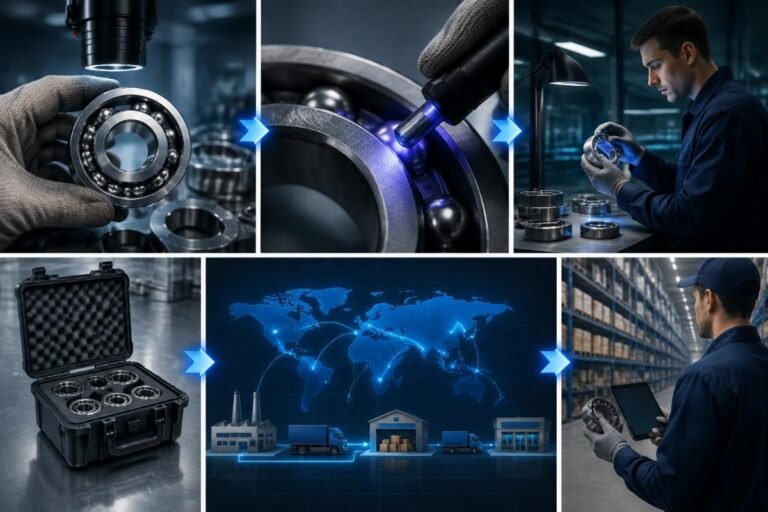
- Request Material Certificates: Ensure the supplier provides mill certificates for the steel used. Genuine sleeves are typically made from high-quality carbon steel with controlled hardness. Verify that the material grade matches the brand specifications.
- Check Dimensional Reports: Ask for batch-level dimensional inspection reports. These should include measurements for the bore diameter, outside diameter, width, and crucially, the cone angle. The reports should show actual measured values, not just "pass/fail" stamps.
- Verify Thread Precision: The thread fit class is critical for the lock nut. Poorly cut threads will strip or fail to provide adequate preload. Request samples if possible, or ask for detailed photos of the thread profile under magnification.
- Assess Surface Finish: The cone surface should be smooth and free of tool marks. A rough surface indicates poor grinding practices and will lead to uneven contact with the bearing bore.
In our supply chain, we enforce strict QC processes. Every bulk order undergoes random sampling for dimensional checks. We provide full traceability documentation, linking each batch to its production records. This transparency allows buyers to verify quality before the goods leave the warehouse. When engaging in Adapter Sleeve Sourcing, insist on this level of documentation. It is the only way to ensure that the parts you receive match the specifications you ordered.
What Makes a Reliable Wholesale Partner for Bulk Orders?
Traceability, consistent batch quality, and technical support define reliability.
A reliable wholesale partner does more than ship boxes. They understand the technical risks associated with bearing accessories. They maintain consistent batch quality, ensuring that every sleeve in a large order meets the same standards. Inconsistency is a major issue in the aftermarket, where mixed batches from different sources are common.
For distributors in regions like the Middle East, Africa, and Latin America, having a partner who can consolidate mixed-brand orders is valuable. It simplifies logistics and reduces customs complexity. However, consolidation should not come at the cost of quality control. Each brand and type must be verified independently. [NEED_CITE: Best practices for multi-brand bearing inventory management]
Technical support is another key differentiator. A good partner can advise on equivalent models if a specific brand is unavailable. They understand the nuances of different locking mechanisms and can recommend suitable alternatives for harsh environments. For example, in high-corrosion areas, they might suggest sleeves with enhanced surface treatments or specific material grades.
Our experience in supplying over 80 countries has shown that long-term relationships are built on trust and consistency. We stock genuine products from major brands like SKF, FAG, NSK, and TIMKEN, alongside reliable domestic lines. Our massive spot inventory allows us to fulfill urgent maintenance requirements quickly, minimizing downtime for end-users. When you choose a partner for Adapter Sleeve Sourcing, look for one that offers this combination of product authenticity, logistical flexibility, and technical expertise.
Conclusion
Quality verification prevents costly downtime.
Sourcing adapter sleeves in bulk requires a shift from price-focused buying to value-focused procurement. The hidden costs of failure far outweigh the savings from cheap parts. By verifying cone angles, thread precision, and material certifications, buyers can protect their operations from unplanned shutdowns. A reliable partner provides traceability and technical support, ensuring that every component meets the rigorous demands of heavy industry. Effective Adapter Sleeve Sourcing is not just about finding a supplier; it is about securing operational continuity.