FAG & SKF Spindle Bearings: Wholesale Supplier for European OEMs
Most buyers assume switching spindle bearing brands means full requalification—yet cross-reference charts can match equivalent models within days, not months.
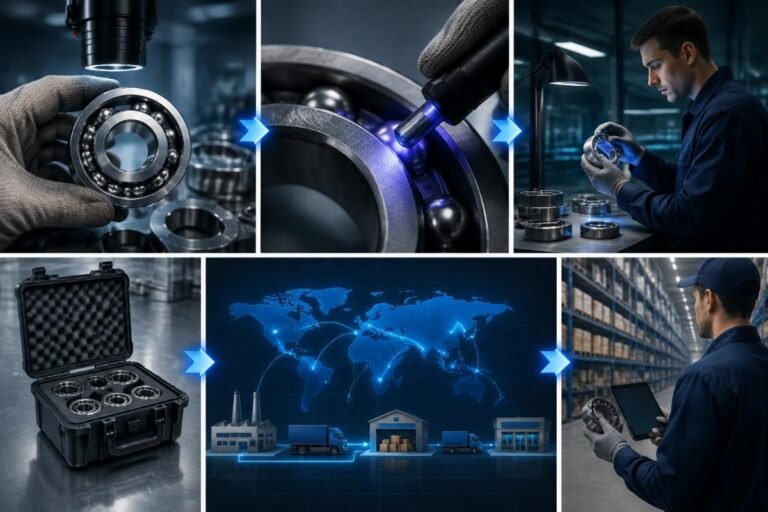
A European machine tool OEM dual-sources FAG and SKF spindle bearings to balance supply security and cost, relying on cross-reference interchange tables, precision-grade matching, and authorized-channel traceability to eliminate counterfeit risk while maintaining spindle uptime.
I spent two weeks at a machine tool facility in Riyadh where a freshly installed spindle ran hot within hours. The FAG 7210 angular contact bearing had been pulled from a "discount channel" out of Dubai. When we cracked it open, the cage color was wrong—off-spec polymer instead of the standard brass. The buyer had chased a small price difference and ended up with a spindle rebuild that cost several times the original savings. That facility now insists on QR-code verification and authorized-distributor documentation before any spindle bearing hits the machine. Across Europe, OEMs are building the same discipline into their sourcing playbooks, treating FAG and SKF spindle bearings as interchangeable assets rather than locked-in brand commitments. [NEED_CITE: European machine tool OEM procurement trends for spindle bearings 2025-2026]
This is where a FAG and SKF spindle bearing wholesale supplier with cross-reference capability becomes the operational backbone—not just a vendor.
Why Do European Machine Tool OEMs Dual-Source FAG and SKF Spindle Bearings?
Dual sourcing between FAG and SKF spindle bearings is a supply-chain resilience strategy, not a cost-cutting shortcut—it protects against single-brand allocation shortages while preserving spindle performance specs.
European machine tool builders have faced repeated allocation cycles over the past several years. When one brand extends lead times for high-precision angular contact spindle bearings, OEMs with dual-qualified part numbers can shift volume to the alternate brand without redesigning the spindle housing or re-running thermal validation. [NEED_CITE: Industrial bearing supply chain allocation patterns in European machine tool sector]
A German spindle manufacturer I worked with qualified SKF 7210 and FAG 7210 as interchangeable on their mid-range CNC lathe platform. The cross-reference validation took several weeks of bench testing—measuring preload decay, thermal rise under continuous duty, and vibration signatures. Once validated, the OEM held both brands in their BOM, giving procurement the flexibility to order whichever had stock. The key was that both bearings met the same P5 precision class and used matched cage designs for the operating speed range. [NEED_CITE: ISO 492 bearing precision class definitions for spindle-grade angular contact bearings]
The real risk is not the brand switch itself—it is sourcing from channels that cannot prove authenticity. A Middle East steel mill once received a batch of what they believed were SKF spindle bearings for their rolling mill drive. The bearings failed within weeks. Forensic analysis showed the raceway surface finish was inconsistent with the manufacturer’s production standards. The mill lost a mid-six-figure sum in unplanned downtime. They now require country-of-origin documentation and authorized-distributor verification for every spindle bearing order.
What Makes FAG and SKF Spindle Bearing Interchangeability Possible?
FAG and SKF spindle bearing interchangeability rests on standardized dimensional envelopes, precision-grade alignment, and preload compatibility—not on brand loyalty.
Both FAG and SKF manufacture angular contact spindle bearings to the same ISO dimensional standards. A 7210 bearing from either brand shares identical bore, outside diameter, and width. The interchangeability question is really about internal geometry—contact angle, cage material, grease fill, and preload grouping. [NEED_CITE: ABMA/ISO bearing interchangeability guidelines for angular contact spindle bearings]
When I help buyers cross-reference between FAG and SKF spindle bearings, the process follows a structured comparison:
- Dimensional envelope: Bore, OD, width must match per ISO 15. Both brands comply.
- Precision class: Spindle applications typically require P5 or P4. Both brands offer these grades. [NEED_CITE: ISO 492 precision class tolerances for radial bearings]
- Contact angle: Standard spindle bearings use 15° or 25° contact angles. The angle must match between brands to preserve preload behavior.
- Cage design: Machined brass cages are standard for high-speed spindle use. Polymer cages may differ in material specification between brands.
- Preload class: Light, medium, or heavy preload must be matched. Both brands use similar preload designation systems, but the exact preload force values should be cross-checked against manufacturer catalogs.
- Grease compatibility: Factory grease fill varies by brand and application. For spindle bearings, the grease type and fill quantity affect thermal behavior and must be validated during interchange testing.
A buyer in Turkey needed to replace a batch of back-ordered FAG spindle bearings with SKF equivalents for a CNC machining center. The cross-reference worked seamlessly because both brands offered the same P5 precision, 15° contact angle, and machined brass cage. The OEM ran a short thermal validation cycle and approved the switch. The entire process took a matter of weeks, not months.
How Do Buyers Verify Authenticity When Sourcing FAG and SKF Spindle Bearings?
Authenticity verification for FAG and SKF spindle bearings requires a three-layer approach: QR-code scanning, authorized-distributor cross-checking, and country-of-origin documentation review.
Counterfeit spindle bearings are not a theoretical risk—they are a daily reality in global bearing trade. The Middle East, North Africa, and parts of Asia remain high-risk regions for fake bearings entering through non-authorized channels. A FAG and SKF spindle bearing wholesale supplier who cannot provide verifiable sourcing documentation is a liability, regardless of how competitive their pricing appears.
The verification process I use with buyers follows three steps:
- QR-code and app verification: Both SKF and FAG have implemented QR-based authentication on their packaging. SKF’s verification app allows buyers to scan the code and confirm the bearing’s production batch and intended distribution region. FAG’s system works similarly through their digital verification tools. [NEED_CITE: SKF and FAG anti-counterfeit verification program details]
- Authorized-distributor registry check: Both manufacturers maintain published lists of authorized distributors by country. A buyer can cross-reference the supplier’s claimed authorization against the official registry. If the supplier is not listed, the sourcing chain is broken.
- Country-of-origin documentation: Genuine FAG and SKF spindle bearings come with mill certificates and packing lists that trace the bearing back to the manufacturer’s production facilities. The documentation should include the bearing’s production batch, date code, and origin plant. Discrepancies in date codes or missing documentation are immediate red flags.
A distributor in North Africa once showed me "FAG" bearings with packaging that looked correct at first glance. The QR code, however, led to a verification page that did not match the bearing model number. The batch code on the inner ring did not align with the outer packaging date. The entire shipment was rejected. The buyer avoided a potential spindle failure that would have cost far more than the price difference they were trying to save.
What Are the Long-Term Operational Benefits of Dual-Sourcing FAG and SKF Spindle Bearings?
Dual sourcing FAG and SKF spindle bearings reduces unplanned downtime, optimizes inventory holding costs, and creates negotiating leverage—provided the interchangeability is technically validated upfront.
The financial case for dual sourcing is not about the per-unit price difference. It is about the cost of a stockout. When a single-brand strategy hits an allocation bottleneck, the alternative is either accepting extended lead times or buying from questionable channels to fill the gap. Both options carry severe risk.
A European machine tool builder I advised maintained a dual-qualified BOM for their spindle bearing requirements across three CNC platform families. They held safety stock of both FAG and SKF equivalents, rotating inventory based on availability and pricing. Over a multi-year period, they avoided a single spindle-related production stoppage caused by bearing unavailability. Their procurement team reported that having two qualified sources also improved their commercial terms—suppliers knew the buyer could shift volume if pricing became uncompetitive.
The upfront investment is technical validation. Cross-referencing FAG and SKF spindle bearings requires bench testing to confirm that thermal behavior, vibration signatures, and preload retention match across brands. This validation is not optional—it is the foundation that makes dual sourcing safe. [NEED_CITE: Machine tool spindle bearing validation protocols for brand interchangeability]
Once validated, the ongoing operational benefits compound:
- Supply continuity: Allocation shortages on one brand can be offset by the other.
- Inventory flexibility: Safety stock can be held in whichever brand offers better availability at the time of purchase.
- Commercial leverage: Dual sourcing prevents single-supplier dependency and improves pricing negotiations.
- Risk mitigation: Counterfeit exposure is reduced when buyers are not forced into emergency purchases from unverified channels.
Conclusion
Dual sourcing FAG and SKF spindle bearings is a proven resilience strategy for European machine tool OEMs, but it demands rigorous cross-reference validation and uncompromising authenticity verification.
The interchangeability between FAG and SKF spindle bearings is technically sound when precision grades, contact angles, and cage designs align. The real discipline lies in sourcing from channels that can prove every bearing’s origin and in validating the interchange before it goes into production. A FAG and SKF spindle bearing wholesale supplier who supports both cross-reference matching and full traceability is not a luxury—they are the foundation of a spindle strategy that keeps machines running.