Electric Motor Bearing for Multi-Site Paper Mills Wholesale Supplier
Price is rarely the primary driver of total cost in multi-site industrial operations.
For multi-site paper mills, standardizing electric motor bearing specifications and consolidating procurement through a verified wholesale electric motor bearings supplier China prevents premature failures in high-humidity wet-end sections and eliminates costly emergency logistics.
I still remember the chaos at a pulp mill group in Southeast Asia. They operated three separate production sites, each with its own maintenance team and purchasing authority. The result was a fragmented supply chain where identical electric motors were fitted with different bearing brands and seal types across the facilities. One site used open deep-groove ball bearings in the wet-end section, where humidity levels are consistently high. Within months, the lack of proper sealing led to rapid corrosion of the rolling elements. The maintenance team faced repeated unplanned downtime, forcing them to pay premium rates for air-freighted replacements. This scenario is not unique. Many large industrial groups suffer from inconsistent maintenance standards due to decentralized purchasing. [NEED_CITE: impact of decentralized procurement on MRO efficiency] By centralizing sourcing and enforcing strict technical specifications, mills can significantly reduce failure rates and streamline inventory management.
Transitioning from fragmented buying to a unified strategy requires more than just finding a low-cost vendor. It demands a partner who understands the technical nuances of paper manufacturing environments and can provide consistent, genuine products across multiple locations.
Why Do Multi-Site Paper Mills Face Recurring Motor Bearing Failures?
Fragmented procurement leads to inconsistent specifications and premature failures in harsh wet-end conditions.
In a typical multi-site operation, different plants often source spare parts independently. This leads to a mix of brands, seal types, and quality levels. In paper mills, the wet-end section presents extreme challenges due to high moisture, steam, and potential chemical exposure. Standard deep-groove ball bearings without appropriate seals are vulnerable in these environments. When one site uses rubber-sealed bearings (such as 2RSH) and another uses metal-shielded ones (such as 2Z), the performance varies drastically. Rubber seals offer better protection against water ingress but may have higher friction, while metal shields are less effective against fine mist and contaminants. [NEED_CITE: ISO contamination codes for pulp and paper environments]
A common mistake is assuming that any "standard" bearing will suffice. However, the specific operating conditions dictate the required seal type and lubrication. Without a centralized technical review, local buyers may opt for cheaper, unsealed options to cut initial costs. This decision often results in early failure, leading to higher long-term expenses due to frequent replacements and production losses. The inconsistency also complicates inventory management, as each site stocks different part numbers for similar applications.
The root cause is not just poor quality but poor specification alignment. When procurement is siloed, there is no mechanism to share best practices or enforce uniform standards. A bearing that works well in a dry warehouse area may fail quickly in a humid paper machine section. Therefore, understanding the environmental demands of each zone is critical before selecting components.
How Does Standardizing Bearing Specs Reduce Unplanned Downtime?
Unified technical selection ensures correct seal types and load ratings for specific mill zones.
Standardization begins with mapping motor models to equivalent bearing specifications across major brands like SKF, FAG, and NSK. Instead of allowing each site to choose arbitrarily, a central engineering team defines the approved list of bearings for each application. For example, all motors in the wet-end section might require bearings with robust rubber seals and high-temperature grease. This approach reduces SKU complexity and ensures that maintenance teams across all sites use compatible parts. [NEED_CITE: benefits of SKU rationalization in industrial MRO]
When specifications are standardized, it becomes easier to predict maintenance needs and plan replacements proactively. Teams can share data on bearing life and failure modes, leading to continuous improvement. Moreover, using recognized global brands ensures consistent quality and performance. Mixing brands without proper equivalence checks can lead to subtle differences in dimensions or tolerances, causing fit issues and premature wear.
| Application Zone | Environmental Condition | Recommended Seal Type | Lubrication Requirement |
|---|---|---|---|
| Wet-End Section | High Humidity, Steam | Rubber Contact Seal (e.g., 2RSH) | High-Temperature, Water-Resistant |
| Dry-End Section | Moderate Dust, Low Moisture | Metal Shield (e.g., 2Z) or Open | Standard Lithium-Based |
| General Utility | Normal Indoor Conditions | Metal Shield or Open | Standard Grease |
This table illustrates how different zones require different technical solutions. By adhering to such a matrix, mills can avoid the pitfalls of using inappropriate components. The key is to base decisions on verified technical data rather than price alone.
Standardization also facilitates better training for maintenance staff. When everyone works with the same types of bearings, they become more proficient in installation and inspection techniques. This reduces human error, which is a significant contributor to early bearing failures. Proper handling, mounting, and lubrication are just as important as the bearing itself.
What Are the Logistics Benefits of Consolidated Wholesale Sourcing?
Centralized ordering enables better inventory control and reduces emergency air-freight costs.
Once specifications are aligned, the next step is to consolidate purchasing. Instead of placing small, frequent orders from multiple suppliers, a multi-site group can place larger, less frequent orders with a single trusted partner. This leverage allows for better pricing and more favorable shipping terms. Container shipments are far more cost-effective than air freight, which is often required for emergency replacements when local stock runs out. [NEED_CITE: cost comparison of air vs sea freight for industrial spares]
Consolidation also simplifies inventory management. With a unified supply chain, it is easier to maintain optimal stock levels across all sites. Excess inventory at one plant can be transferred to another if needed, reducing overall holding costs. Furthermore, working with a single supplier reduces administrative overhead and improves communication. Issues related to quality or delivery can be resolved more efficiently when there is a direct relationship with the provider.
A wholesale electric motor bearings supplier China can offer the scale and flexibility needed for such consolidated orders. They can handle mixed-brand containers, ensuring that all required SKUs arrive together. This approach minimizes the risk of partial shipments and delays. Additionally, having a reliable local spot stock plan can further reduce dependency on urgent international shipping.
The financial impact of this strategy is substantial. By avoiding emergency air-freight charges and reducing inventory waste, mills can achieve significant cost savings. More importantly, the reliability of supply ensures that production schedules are maintained without interruption. This stability is crucial for meeting customer demands and maintaining competitiveness in the market.
How to Implement a Cross-Brand Bearing Standardization Strategy?
Use equivalent model mapping and rigorous supplier verification to maintain quality across sites.
Implementing a cross-brand strategy requires careful planning and execution. The first step is to create a comprehensive mapping of all existing motor models to their corresponding bearing equivalents. This involves identifying the original equipment manufacturer (OEM) specifications and finding suitable alternatives from other reputable brands. For instance, an SKF bearing might be equivalent to an FAG or NSK model with similar dimensions and load ratings. [NEED_CITE: cross-reference guidelines for major bearing brands]
It is essential to verify the authenticity of these equivalents. Not all bearings labeled with a brand name are genuine. Counterfeit products can look identical but lack the material quality and precision of authentic items. Working with a supplier who provides full traceability documentation is critical. This includes certificates of origin, material test reports, and batch numbers. Such documentation ensures that every bearing meets the required standards.
| Verification Step | Action Required | Outcome |
|---|---|---|
| Model Mapping | Identify OEM specs and find cross-brand equivalents | Unified technical standard |
| Supplier Audit | Check authorization and traceability capabilities | Verified genuine supply |
| Sample Testing | Validate performance in controlled conditions | Confirmed suitability |
| Pilot Rollout | Implement in one site before full deployment | Risk mitigation |
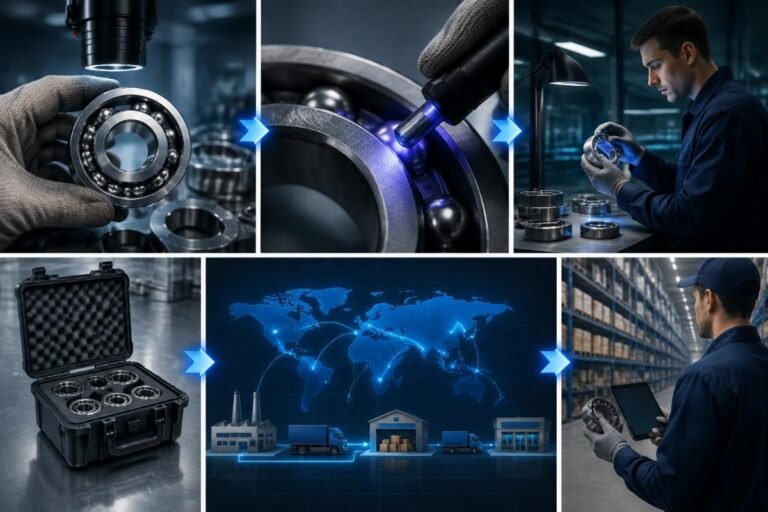
This structured approach minimizes risks during the transition. Starting with a pilot rollout allows the team to identify any issues before scaling up. Feedback from the pilot site can be used to refine the process and address any unforeseen challenges.
Our global full-range supply covers mainstream brands including SKF, FAG, NSK, NTN, TIMKEN, KOYO, NACHI, and IKO, alongside reliable domestic Chinese lines. We support clients in mapping equivalents and verifying authenticity for standardized multi-site orders. Technical consultation is available to help select the right bearings for specific applications, ensuring optimal performance and longevity. By leveraging our expertise and inventory, mills can achieve a seamless transition to a standardized procurement model.
Conclusion
Standardization transforms bearing procurement from a cost center into a strategic advantage.
Multi-site paper mills benefit significantly from unifying their electric motor bearing specifications and consolidating their supply chain. This approach reduces unplanned downtime, lowers logistics costs, and simplifies inventory management. By focusing on technical consistency and partnering with a verified wholesale electric motor bearings supplier China, industrial groups can ensure reliable operations across all their facilities.