
Schaeffler Group SKF 6205 22320 Wholesale Supplier Cross-Ref 2026
Matching a bearing number across brands does not mean matching performance. Internal clearance, cage material, and production batch origin can turn a "same-size replacement" into a repeat failure within days.
In 2026, Schaeffler and SKF remain firmly positioned among the top global bearing manufacturers within the eight-major-player oligopoly, yet model interchangeability between them demands careful verification of suffix codes, clearance classes, cage design, and seal types — not just dimensional equivalence. Genuine sourcing through authorized channels, combined with batch-level traceability, is the only reliable defense against counterfeits and mismatched internals.
I spent three months at a cement plant in Lagos, watching a kiln main-shaft bearing burn out, get replaced with a locally sourced "same-size" unit, and burn out again within days. The entire production line sat idle. When I tore the failed unit apart, the outer ring raceway showed clear spalling, and the internal clearance was visibly wrong — the number matched, but the internal geometry did not. That kind of failure is not rare; it is the standard pattern when buyers treat cross-reference as a simple number swap. [NEED_CITE: root cause distribution of bearing failures per ISO 15243 classification]
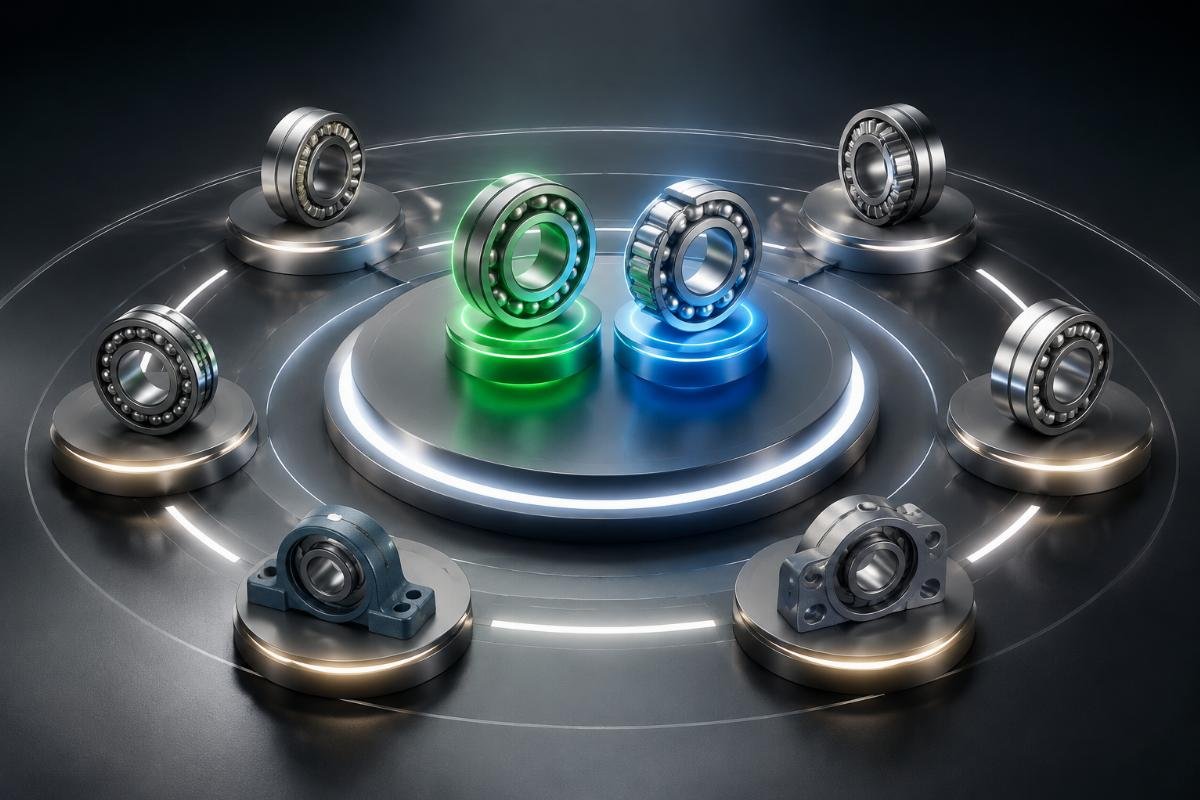
The rest of this article walks through what the 2026 market data actually shows, why cross-reference is more than a number match, how to verify authenticity beyond a QR scan, and how to source through legitimate channels — all from the perspective of someone who has dismantled enough failed bearings to know where the real risks hide.
H2: What Is the Actual Market Position of Schaeffler and SKF in 2026?
Schaeffler and SKF continue to hold dominant positions within the global bearing market, which remains controlled by eight major manufacturers accounting for the majority of worldwide revenue, though domestic Chinese producers are accelerating penetration in the mid-tier segment.
Industry research consistently identifies the same eight players — SKF, Schaeffler, NSK, JTEKT, NTN, Timken, MinebeaMitsumi, and Nachi — as the core group shaping global supply. [NEED_CITE: market share concentration among eight major bearing manufacturers in 2023-2026 reports] These companies built their positions over decades through proprietary heat treatment processes, controlled steel sourcing, and deep application engineering capabilities. Schaeffler and SKF, in particular, remain the default specification for heavy industrial, wind energy, and high-precision machine tool applications across most regions.
However, the landscape is shifting at the edges. Chinese manufacturers such as LYC, ZWZ, and C&U have moved from purely mid-range supply into batch delivery for wind turbine main-shaft bearings and railway axle-box units. [NEED_CITE: domestic Chinese bearing manufacturers entering high-end segments by 2025-2026] This does not erase the Schaeffler-SKF dominance in critical applications, but it does mean that buyers in non-critical, cost-sensitive segments now have more options — and more confusion about which grade they are actually purchasing.
From a sourcing standpoint, this means the Schaeffler Group SKF 6205 22320 wholesale supplier cross-ref question is no longer just about availability. It is about knowing which tier of product you are buying, and whether the supplier can prove the origin. A distributor offering "equivalent" units without batch documentation is almost certainly mixing genuine stock with unverified alternatives.
H2: Does Model Interchange Between Schaeffler and SKF Really Mean Performance Equivalence?
A bearing model number can be cross-referenced across brands, but internal clearance group, cage material, seal design, and production origin often differ — and any one of these mismatches can cause premature field failure.
This is the single most misunderstood point in industrial bearing procurement. Buyers see a FAG 22320 and an SKF 22320, assume they are functionally identical, and place an order based on price alone. The reality is that suffix codes carry the real engineering information.
Consider a spherical roller bearing specified as 22320 E1/C3 from Schaeffler versus 22320 E/C3 from SKF. The base dimensions are identical. But the cage design differs — Schaeffler’s E1 suffix indicates a specific stamped steel cage geometry, while SKF’s E design uses a different cage profile. Under high-vibration conditions in a vibrating screen application, these cage differences affect lubricant retention and roller guidance. I have seen units from the "wrong" brand survive in a low-vibration gearbox but fail within weeks when installed in a screen where vibration is continuous. [NEED_CITE: cage design influence on lubricant retention and roller guidance in vibrating applications per manufacturer technical documentation]
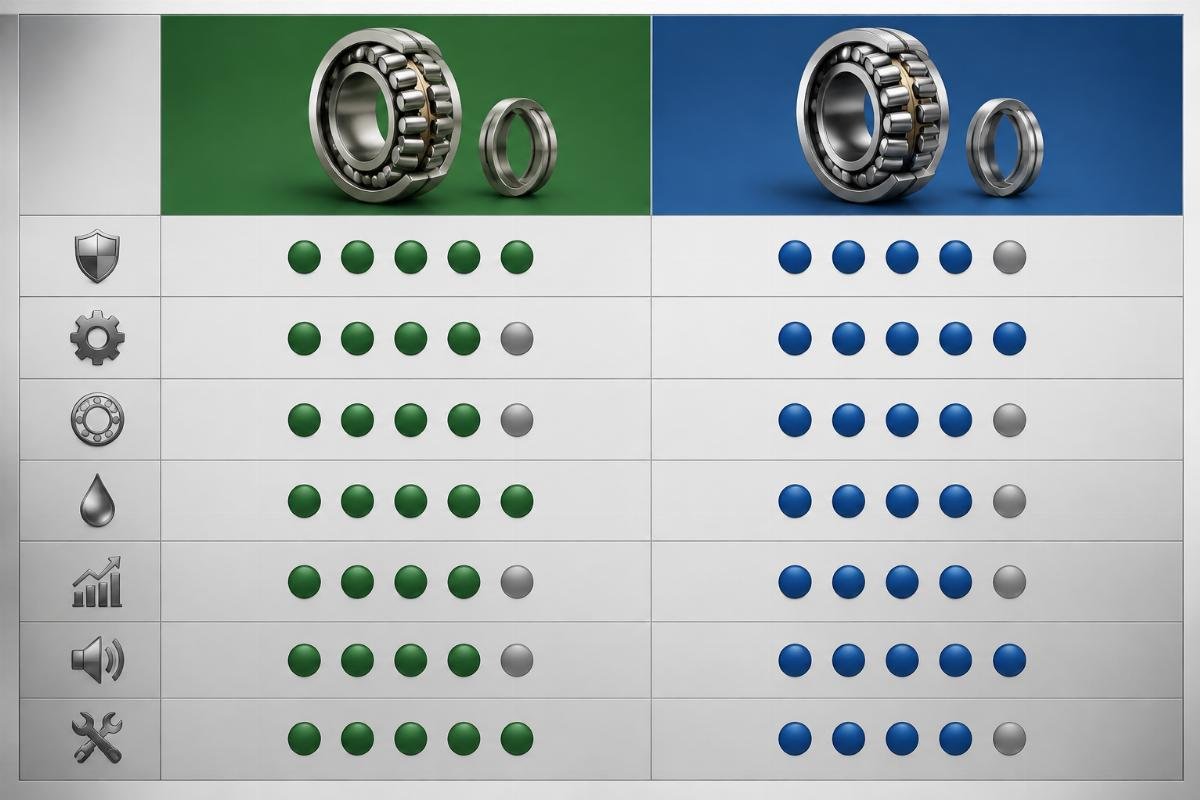
The interchange matrix below shows the key parameters that must be verified — not just the base model number.
| Parameter | What to Check | Risk if Ignored |
|---|---|---|
| Base model number | Dimensional match | Obvious — wrong fit |
| Clearance class (C2/C3/C4/CN) | Must match or exceed original spec | Overheating, premature fatigue |
| Cage material and design | Stamped steel vs machined brass vs polymer | Vibration sensitivity, speed limit mismatch |
| Seal type | Open / 2RS / 2Z / specialized | Contamination ingress in dirty environments |
| Origin code on ring | Production facility identifier | Counterfeit or parallel-import risk |
| Grease fill (if sealed) | Type and fill quantity | Incompatibility with existing lubricant |
A Middle East distributor once asked me to compare a FAG 22320 inquiry against the SKF equivalent. The buyer wanted the cheapest option. When I pulled the suffix details, the FAG unit specified a machined brass cage for high-temperature kiln duty, while the SKF quote referenced a standard stamped steel cage. The price difference was small. The field consequence would have been catastrophic — the steel cage would have degraded under sustained high-temperature operation. The buyer switched back to the correct specification after seeing the comparison.
This is where a complete Schaeffler Group SKF 6205 22320 wholesale supplier cross-ref service becomes essential. It is not about swapping numbers. It is about matching every suffix, every internal design feature, and every application requirement — then confirming that the stock on offer actually carries those features.
H2: How Do You Verify Authenticity Beyond a Simple QR Code Scan?
QR codes on bearing packaging can be replicated by counterfeiters. Genuine verification requires a three-layer approach: authorized channel confirmation, physical packaging inspection, and batch-level documentation cross-check.
The counterfeit market has evolved well beyond fake labels on obviously poor-quality units. Modern counterfeits carry working QR codes that link to cloned verification pages. I have handled units where the QR scan returned a "genuine" result, but the inner ring engraving font was slightly off, and the batch number did not exist in the manufacturer’s production records.
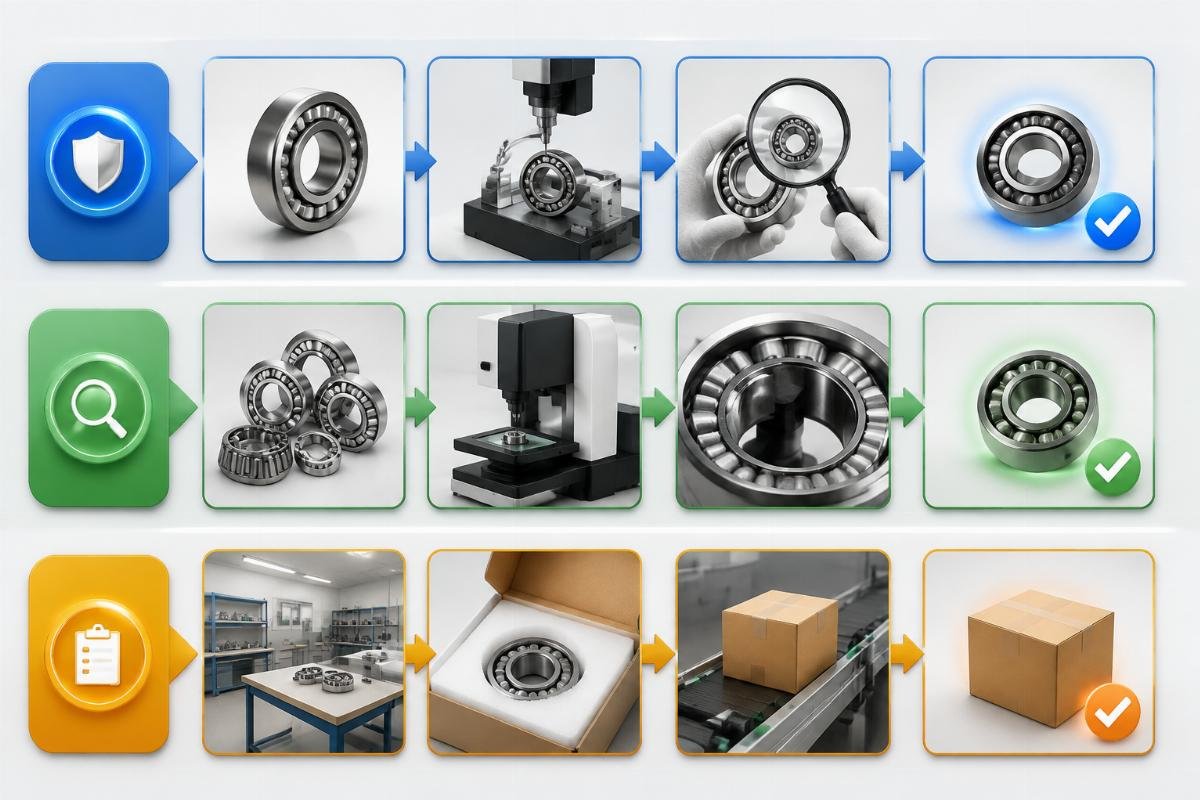
The verification process I follow on every shipment has three layers.
Layer one: authorized channel confirmation. Before any transaction, verify that the supplier appears on the brand’s official authorized distributor list. Both Schaeffler and SKF maintain publicly searchable dealer locators on their websites. [NEED_CITE: official authorized distributor verification tools from Schaeffler and SKF websites] A supplier who cannot provide their authorization certificate or whose name does not appear in the brand’s directory is a red flag, regardless of how competitive their price is.
Layer two: physical packaging inspection. Genuine packaging carries specific security features — holographic labels, micro-text printing, color-shifting ink, and tamper-evident seals. The engraving on the bearing itself must match the brand’s current font standards, including the depth and spacing of the designation code. Counterfeit engraving is often shallower, with inconsistent character spacing.
Layer three: batch documentation cross-check. Request the mill test certificate or batch traceability document for the specific lot number marked on the bearing. Cross-reference this lot number with the manufacturer’s production records through your authorized channel contact. A genuine supplier will provide this documentation without hesitation. A supplier who deflects or offers only "sample certificates" is not selling traceable stock.
A Southeast Asian maintenance contractor once purchased a batch of deep groove ball bearings from an online platform at a significant discount. The QR codes scanned as genuine. But when the bearings were installed in a continuous-duty conveyor, failures began appearing within weeks. Investigation revealed the batch numbers on the bearings did not correspond to any production records held by the brand’s regional office. The entire batch was counterfeit — sophisticated enough to fool a QR scan, but not sophisticated enough to replicate actual production traceability.
When you are evaluating a Schaeffler Group SKF 6205 22320 wholesale supplier cross-ref partner, the ability to provide full batch documentation is the single most important differentiator between a genuine sourcing channel and a gray-market trader.
H2: How Do You Approach Cross-Brand Selection When Replacing a Failed Bearing?
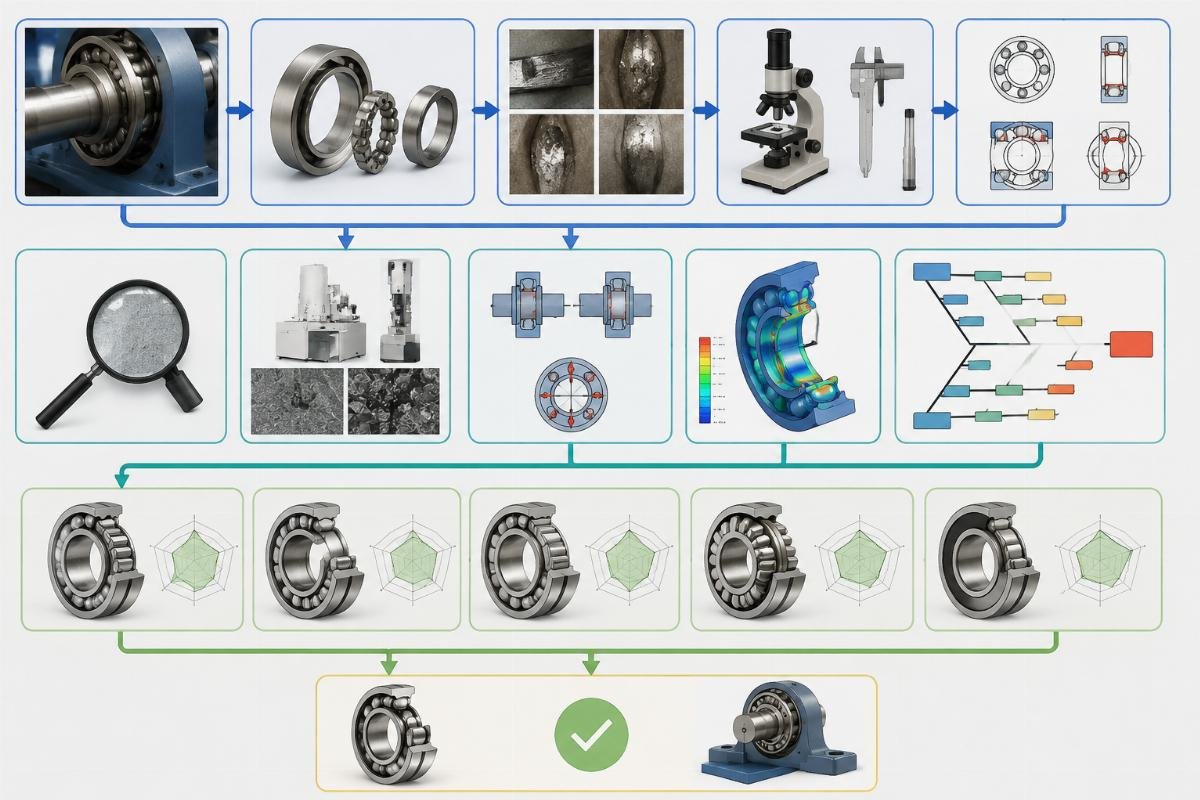
Start from the failure pattern on the dismantled unit, work backward to the actual operating conditions, and then match the brand and suffix specification to those conditions — do not simply copy the original model number from a sample catalog.
This is the methodology I developed after years of seeing the same mistake repeated: a bearing fails, the maintenance team reads the model number off the old unit, orders a replacement, and the new unit fails in the same way. The root cause was never addressed because the selection was based on a number, not on the application reality.
The correct approach follows a clear sequence.
Step one: dismantle and inspect the failed bearing. Identify the failure mode using the standard classification — fatigue spalling, abrasive wear, corrosive damage, lubrication failure, plastic deformation, or electrical erosion. [NEED_CITE: bearing failure mode classification per ISO 15243] Each failure mode points to a different set of operating conditions and, therefore, a different bearing specification requirement.
Step two: reconstruct the actual operating conditions. Temperature range, load profile (steady vs shock), speed range, vibration level, contamination exposure, and lubrication method. These parameters determine the required clearance class, cage material, seal type, and grease specification — not the other way around.
Step three: match brand and suffix to the conditions. Once the operating requirements are clear, select the brand and specific suffix code that addresses those requirements. For example, a high-temperature kiln application demands a machined brass cage and specific high-temperature grease fill. A high-vibration screen application demands a cage design optimized for roller guidance under continuous vibration. A contaminated environment demands effective sealing with the correct seal lip material.
Step four: verify cross-brand equivalence if substituting. If the original brand is unavailable and a cross-brand substitution is necessary, compare every suffix parameter — not just the base model. Use the manufacturer’s technical documentation to confirm that the alternative brand’s suffix code delivers the same internal design features. [NEED_CITE: cross-reference technical documentation from Schaeffler and SKF selection manuals]
A European wind farm operator faced a situation where their specified brand of main-shaft bearing had extended lead times. They considered switching to an alternative brand based on dimensional equivalence alone. When we reviewed the original specification, the bearing required a specific internal clearance class optimized for the thermal expansion profile of the shaft under operational temperature gradients. The alternative brand’s standard clearance would have resulted in excessive preload at operating temperature, dramatically reducing service life. By working through the selection methodology, we identified the correct suffix code from the alternative brand that matched the thermal requirements — and avoided a failure that would have cost a mid-six-figure sum in turbine downtime.
This is the level of technical rigor that a competent Schaeffler Group SKF 6205 22320 wholesale supplier cross-ref partner must bring to the table. It is not about having a cross-reference chart. It is about understanding what the chart means in the context of your specific application.
Conclusion
The 2026 bearing market remains dominated by Schaeffler and SKF within the eight-major-player structure, but model interchangeability between brands requires suffix-level verification, not just dimensional matching. Authenticity demands three-layer verification beyond QR scanning, and correct selection starts from failure analysis — not from catalog numbers.
Genuine sourcing through authorized channels, with full batch traceability and application-driven specification matching, is the only approach that protects against the real costs of counterfeits and mismatched internals — costs that far exceed any upfront price savings from unverified supply.