German Tier-1 FAG SKF Bearing Wholesale Supplier – Cross-Reference
Most buyers assume identical model numbers mean identical performance across brands. In reality, internal clearance, cage material, and lubricant fill determine whether a cross-referenced bearing survives the application.
To source genuine German Tier-1 FAG and SKF bearings, buyers must verify authenticity through authorized distribution chains, validate country-of-origin steel stamps, and apply cross-reference interchange tables that account for dimensional series and clearance classes—not just model numbers.
I still remember a shipment that arrived at a Middle Eastern port: a full container of FAG spherical roller bearings, boxes neatly palletized, paperwork in order. The local buyer’s technician opened one box, held the outer ring under a halogen lamp, and immediately noticed the laser-etched font looked slightly too uniform. We pulled ten units at random, checked the batch codes against the manufacturer’s production registry, and found that only a fraction traced back to a legitimate German facility. The rest were rebranded by a middleman who had mixed genuine and counterfeit stock. That single incident reinforced a principle I follow on every order: never trust paperwork alone—trace the steel stamp, verify the authorized chain, and cross-reference the application specs before the goods leave the warehouse. [NEED_CITE: ISO 15243 damage classification and root-cause analysis framework]
Let me walk you through the verification logic, cross-reference rules, and sourcing channels that separate reliable industrial supply from costly guesswork.
Why German Tier-1 FAG & SKF Bearings Dominate Industrial Applications?
FAG and SKF have set the benchmark for precision bearing manufacturing for well over a century, and their dominance in heavy industry stems from metallurgical consistency and application-specific engineering rather than brand reputation alone.
When I first started handling customs declarations at Yantian Port, I noticed something interesting: shipments labeled under HS code 8482 that carried German or Swedish origin certificates consistently cleared inspection faster and faced fewer disputes at destination. The reason was traceability. Both FAG (originating from Schweinfurt, Germany) and SKF (headquartered in Gothenburg, Sweden) maintain tightly controlled production facilities with batch-level traceability tied to heat numbers and forging records. [NEED_CITE: ABMA/ISO/TC4 standards for bearing dimensional and tolerance specifications]
FAG’s X-life designation, for instance, signals optimized internal geometry and surface finish that extends fatigue life under heavy loads—a designation I’ve seen make the difference between a bearing lasting through a scheduled maintenance window versus failing mid-shift on a continuous casting line. SKF’s Explorer-class bearings follow a similar philosophy, with controlled inclusion density and proprietary heat treatment protocols that resist micro-pitting in contaminated lubrication environments.
A European wind farm operator once told me they switched from a no-name alternative to SKF main shaft bearings after experiencing repeated gearbox failures. The cost difference was noticeable, but the unplanned downtime savings were orders of magnitude larger. That is the economics of Tier-1 sourcing: the bearing itself is a fraction of the total system cost, but its failure triggers cascading losses.
How to Verify Authenticity of FAG & SKF Bearings Before Purchase?
Authenticity verification requires combining QR-code scanning, authorized distributor confirmation, country-of-origin steel stamp inspection, and packaging integrity checks—no single method is sufficient on its own.
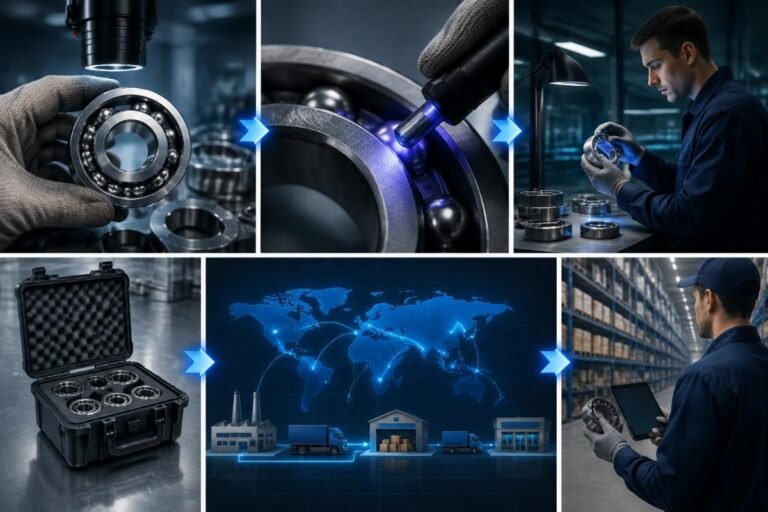
Here is the verification sequence I apply on every incoming shipment:
First, scan the QR code or data matrix on the outer packaging using the manufacturer’s official application. SKF provides the "SKF Authenticate" app, while FAG/INA products can be checked through the Schaeffler verification portal. A successful scan returns batch information, production date, and factory origin. However, sophisticated counterfeiters have begun replicating QR codes that redirect to cloned websites, so the scan result must be cross-checked against the physical stamp.
Second, inspect the steel stamp on the bearing itself. Genuine FAG bearings carry laser-etched or stamped markings that include the brand logo, model designation, and origin code (such as "DE" for Germany or specific factory identifiers). The font on authentic SKF bearings features characteristic proportions—the letter "S" has a distinctive taper, and the "K" carries a subtle notch on the vertical stroke that counterfeit molds rarely reproduce accurately. [NEED_CITE: manufacturer-specific font and stamp identification guidelines for anti-counterfeit verification]
Third, request the authorized distributor certificate from your supplier. A legitimate German Tier-1 FAG SKF bearing wholesale supplier should be able to provide a current authorization letter from the manufacturer or a tier-one master distributor. I always ask for the certificate number and verify it directly with the brand’s regional office.
A Latin American maintenance shop once received a batch of TIMKEN tapered roller bearings where the QR codes scanned successfully—but the steel stamps showed inconsistent depth and the packaging inner flaps lacked the security fiber pattern. We traced the batch and discovered the QR codes had been copied from a legitimate shipment and printed onto counterfeit packaging. The lesson: QR verification is necessary but not sufficient.
What Are the Key Cross-Reference Interchange Rules Between SKF, FAG, NSK, and TIMKEN?
Cross-reference interchange between major bearing brands requires matching not only the basic model number but also the dimension series, internal clearance class, cage design, and lubricant specification—model equivalence alone does not guarantee functional equivalence.
This is where many buyers make costly mistakes. A SKF 6206 and a FAG 6206 share the same basic dimensions, but the suffix designations reveal critical differences. For example, SKF’s C3 clearance and FAG’s C3 clearance both indicate greater-than-standard internal clearance, but the exact micrometer range can vary slightly between manufacturers due to different tolerance interpretations. When I build a cross-reference table for a client, I always map the full designation including suffixes.
Here is a simplified interchange framework I use for common deep groove ball and spherical roller bearings:
| Brand | Basic Model | Clearance Class | Cage Type | Lubricant Fill |
|---|---|---|---|---|
| SKF | 6206 | C3 | Standard steel | Standard |
| FAG | 6206 | C3 | Standard steel | Standard |
| NSK | 6206 | C3 | Standard steel | Standard |
| TIMKEN | 6206 | C3 | Standard steel | Standard |
For spherical roller bearings, the interchange becomes more nuanced. A FAG 22320 E1 and a SKF 22320 CC share the same bore and outer diameter, but the cage design differs—FAG uses a centered window cage while SKF uses a roller-centered design. In high-vibration applications such as vibrating screens, this difference affects cage stress and fatigue life. [NEED_CITE: bearing cross-reference interchange methodology per ISO dimension series standards]
An African mining client needed to replace worn SKF 6206 bearings on conveyor pulleys but could only source NSK locally. I provided a cross-reference confirming dimensional compatibility, but I also flagged that the NSK variant had a different grease fill volume. We specified a re-greasing interval adjustment to compensate. The installation ran without issue, but the point stands: cross-reference is not just about physical fit—it is about matching the entire operating specification.
How to Source Genuine FAG & SKF Bearings Through Authorized Channels?
Sourcing genuine bearings requires purchasing from authorized tier-one distributors who can provide verifiable authorization certificates, batch traceability to factory records, and transparent country-of-origin documentation.
The global bearing market is flooded with unauthorized sellers, particularly on online marketplaces where prices appear attractive but provenance is unverifiable. I have seen buyers receive bearings with packaging that looks authentic—correct logos, proper color schemes, even holographic stickers—only to discover upon inspection that the bearings inside were reconditioned or outright counterfeit.
When I source for a client, I follow a strict chain: I confirm the supplier’s authorization status with the manufacturer’s regional headquarters, request the batch number and trace it to the production facility, and verify the country of origin matches the documentation. For FAG bearings, this means confirming whether the production site is in Germany, China, or another authorized facility—each carries its own stamp code, and the buyer should be informed of the origin before shipment.
A Middle East steel mill procurement manager once asked me why my quotation was higher than an online listing for the same FAG 22320 model. I walked him through the authorization chain: my supply came directly from a tier-one distributor with full batch traceability, while the online listing had no verifiable authorization and could not confirm origin. He chose to test a small batch from the online source first. Three months later, he called back—several bearings had failed prematurely, and the online seller was unresponsive. We supplied a replacement batch with full documentation, and he has been a regular client since.
The key is to treat the German Tier-1 FAG SKF bearing wholesale supplier relationship as a partnership in risk mitigation, not just a transaction. Ask for the authorization certificate. Ask for the batch trace. Ask for the origin stamp photo. A legitimate supplier will provide all of this without hesitation.
What Are the Hidden Costs of Counterfeit Bearings in Industrial Operations?
Counterfeit bearings introduce premature failure risk, unplanned downtime, and potential safety hazards—the total cost of a fake bearing in service can multiply the original purchase price many times over.
The economics of counterfeit bearings are deceptively simple at the point of purchase but devastating in operation. A bearing that costs a fraction of the genuine price seems like a smart saving—until it fails inside a critical gearbox, halting a production line for hours or even days. The direct costs include replacement parts, labor for disassembly and reassembly, and lost production revenue. The indirect costs—safety incidents, reputational damage, contractual penalties—are harder to quantify but often larger.
I have reviewed failure analysis reports where counterfeit bearings showed material inconsistencies: incorrect hardness, poor surface finish on raceways, and cage material that did not meet the specified standard. These defects accelerate fatigue crack initiation and propagation, leading to spalling and catastrophic failure well before the expected service life. [NEED_CITE: bearing failure mode analysis and cost-of-failure studies per industry maintenance benchmarks]
A Southeast Asian cement plant replaced a set of spherical roller bearings on a kiln support with a low-cost alternative. Within weeks, the bearings showed signs of excessive wear. The kiln had to be shut down for an unplanned inspection, costing the plant a mid-six-figure sum in lost production. The investigation traced the failure to substandard material in the counterfeit bearings. The lesson: the bearing is not a commodity item—it is a precision component where material integrity directly determines system reliability.
When you evaluate a German Tier-1 FAG SKF bearing wholesale supplier, consider the total cost of ownership, not just the invoice price. Authentic sourcing, verification support, and cross-reference guidance are not value-added extras—they are essential safeguards against the hidden costs of counterfeits.
Conclusion
Authenticity verification, cross-reference accuracy, and authorized sourcing form the three pillars of reliable industrial bearing procurement. German Tier-1 FAG and SKF bearings deliver proven performance in demanding applications, but only when they are genuine, correctly specified, and properly traced. Buyers who invest in verification processes and work with transparent suppliers protect their operations from the far greater costs of counterfeit failures.